It’s a big night tonight…what with the elections.
I’ve been running around a bit today, and I picked up a couple of newspapers so I can see what they are saying about the election. I figure I’ll buy some tomorrow too and maybe on Wednesday. Then, I went up to the Fulbright offices to pick up an invitation to an election party held by the US embassy. It starts at 10 PM tonight (just after dinner in Spanish time), and I thought I might go for an hour or two. 🙂 That would be around 3 PM in Oklahoma and 1 PM in California, so voting will still be in process there.
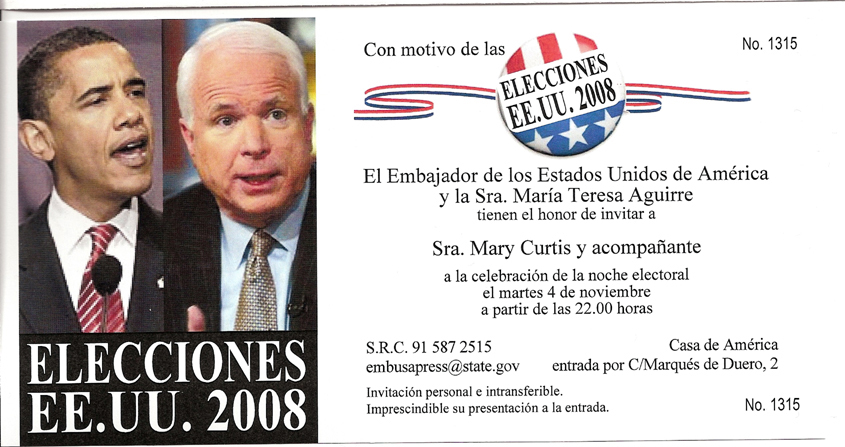
The invitation to the election party!
What else? For lunch, I went to El Pastor–the Bolivian restaurant near our apartment, and on the news, they talked a bit about the American election. The 3 Spaniards at the table next to me were talking about it. All eyes are on America today. The Spaniards joked that the “state” of Spain and the “state” of France, etc. should get a vote. 🙂 It’s funny when you think that we rarely know who is running for prime minister or president of most other countries–even Canada and Mexico which are right next door.
So here is a little international quiz. Name the current leaders of:
- Canada
- Mexico
- United Kingdom
- Australia
- Germany
- France
- Italy
- Portugal
- Russia
- Japan
- Spain
Sometimes the things that stay with me and that I want to remember are the little things, the differences, the details that will fade into the background as I get used to my life in Spain. So here goes…
Routines
Here is a view of central Madrid from the top floor of the Matrix building where Puck works which is south of the center. You can see the tower of Madrid to the right. Puck´s been lucky to make a friend at work–Germán–who has shown him the ropes. People often go out for breakfast around 11 (coffee and a pastry) for about a half hour. Lunch is typically an hour sometime between 2-4 PM. They leave work around 6 PM at Matrix, but some places close for a lunch/siesta from 2 to 4 or 5 PM and then stay open until 8 PM. On Fridays, many places close early. Puck works at home those days because his office closes at 3 PM. Dinner is usually around 9-10 PM. In fact, many restaurants don’t open for dinner until 8 or 8:30 PM, and some stay open until midnight.
Menu of the Day
Most restaurants here have what they call the Menu of the Day which gives you the option of 2-3 things for the first plate, 2-3 things for the second plate, a drink, and then either coffee or dessert for a fixed price. It’s usually a pretty good deal. The first plate is often things like salad or soup, but sometimes it is also something like paella (rice dish). The second plate is some type of meat usually served with French Fries. French Fries are big here. They get served with all sorts of things.
Shopping
Shopping is interesting in Madrid. Back home it is easy to drive to a store, buy tons of groceries or other things, drop them in the car and keep on the go. When dependent on public transport (even with a car parking near a store is often an issue) and one’s own two feet, the way one thinks of purchases changes. We pick up many things from the small local convenience stores (alimentaciones and bazares) because they aren’t far away. When shopping at the larger stores, we’ve had to shop while keeping in mind how much we can (and want) to carry for the 10-15 minute walk home or on the metro. They also have bags on wheels which they use when shopping, and we just recently bought one. I’m looking forward to seeing how it expands my shopping possibilities. 🙂
The Metro
The metro is an interesting creature. It’s amazing to the think of the labrynth of tunnels extending throughout the city, descending deeper and deeper below the streets and apartments. The temperature is often cool on the platform, though there are some warm spots. When the trains are full it can be quite hot, but otherwise it’s a comfortable temperature. Now with the weather turning cold, it means wanting to wear layers to adjust to the changes or just bearing the warmth. Also, scarves are a big clothing item here–even when people don’t wear jackets, and now that the weather is turning I see more hats. Being on the metro, you start to notice shoes too. In the summer, the women wear lots of sandals and the younger generation wears sandals. Flats are pretty popular too. Now that it turned rainy and cold, the women are almost all out in boots–with or without heels. It’s interesting to see the styles change.
Listening to Music
Many people bring books to read on the metro, and there are lots of people with MP3 players too. I tried listening to music one day. It was a bit surreal–walking around to my own tune with the sounds of the city blocked out. I felt a bit disconnected from everything. It’s hard to imagine those youths who walk around all day–moving to their own beat, shut into their own acoustic world. Seeing everything going on around them but not hearing it.
Note added November 4, 2008.
Halloween
As for Halloween, it’s an American holiday. However, while we didn’t see any children dressed up in Madrid, there were teenagers in the metro and gathering at different spots in the city who did dress up. I also chatted with a friend in Argentina, and she says that there the teenagers often have a party or picnic (it’s summer there) and dress up for photos. Both people in Spain and Argentina mentioned that the Halloween presence has worked its way into society through globalization, mostly through TV and films.
For the most part I’m avoiding online discussions about the elections, but several people have asked about what people in Spain are saying about the election.
Spaniards are typically much more aware of what is going on in the USA than Americans are of what is happening in Spain. They are following the election, and several have joked that really people outside the States should be able to vote in our elections too since whoever is elected affects their lives too–though some have then commented that really that wouldn’t be a good idea.
Most people over here who have talked with me/us about the election would like to see Obama elected and have strong reservations about Palin’s selection as McCain’s VP. The Spaniards can typically give you concrete reasons for their support of Obama. One of their concerns is McCain’s age/health and Palin’s conservative views and lack of experience–including a lack of a passport until fairly recently and the lack of a broader world view. They are also aware that Obama has spoken more favorably of Spain as an ally while McCain in an interview refused to say that he would meet with the Spanish prime minister and seemed to think that Spain was part of Latin America. While that didn’t win McCain any points, most Spaniards don’t specifically mention it. They are also curious about the role racism might play in the elections, and some recently have expressed concerns about Obama being assassinated–especially after the recently revealed plot to kill him.
I just met an American over here who will be meeting at the Democratic party headquarters here in Spain on election day to watch the results come in. Apparently, there is a fairly large group here in Spain. I never would have thought to find our political parties organized in other countries where Americans are living.
Puck is currently working hard at a tradeshow here in Madrid–from 9 AM until 7 PM, so he leaves the house at 8 and gets home around 8. The tradeshow ends this Saturday, so we’ll have a wee bit of time together before he flies home for 2 months. He’ll make it back just in time to vote and will be staying with some of our friends in Davis. The weather here has been cold and rainy lately–though today we had a relatively clear sky most of the day and no rain.
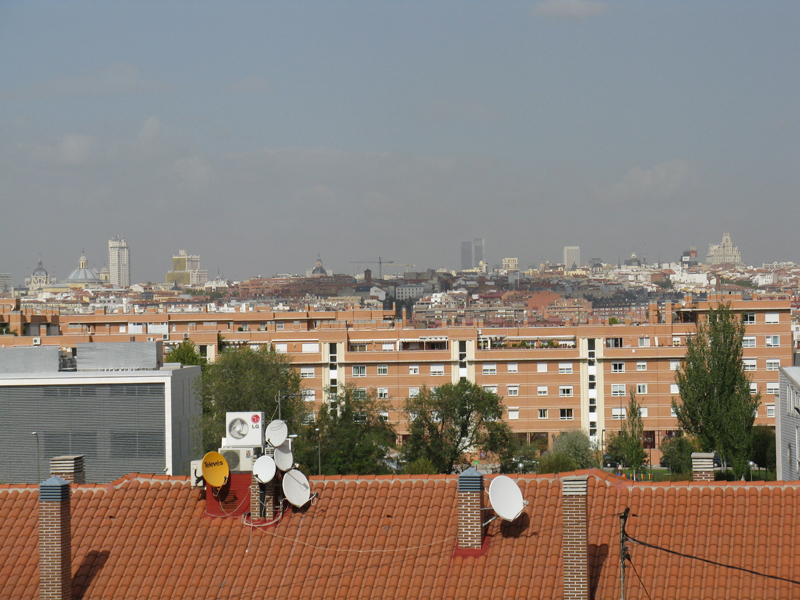
The upper floor where Paco works in Madrid has a great view of the city. To the left, you can see the Tower of Madrid and the other large building (with yellow building-stuff hanging on it) that are on the Plaza de España.
Tuesday night I went to a book presentation at one of the local museums. I had expected to see some of the Fulbright people there, at least the coordinators, but it turned out to just be me…and a room full of people I didn’t know. However, the gathering was for a book on Madrid’s Plaza Mayor by an American scholar (former Fulbrighter) Jesús Escobar. During the cocktails after the presentation, I introduced myself to historian James Amelang and later to Escobar (who introduced me to several other history professors). Amelang invited me to a monthly cultural history colloquium–with the first one of the academic year being the next day–Wednesday morning.
I went to the cultural history colloquium and heard a lecture on delincuency in Miguel de Cervantes’ prose. There were 7 of us there–representing the fields of history, literature and art history, and after the discussion, 5 of us went out for lunch together. It was a very positive experience, and I enjoyed getting to hear everyone’s opinions and having the opportunity to chat with them about what they were doing.
Our Street
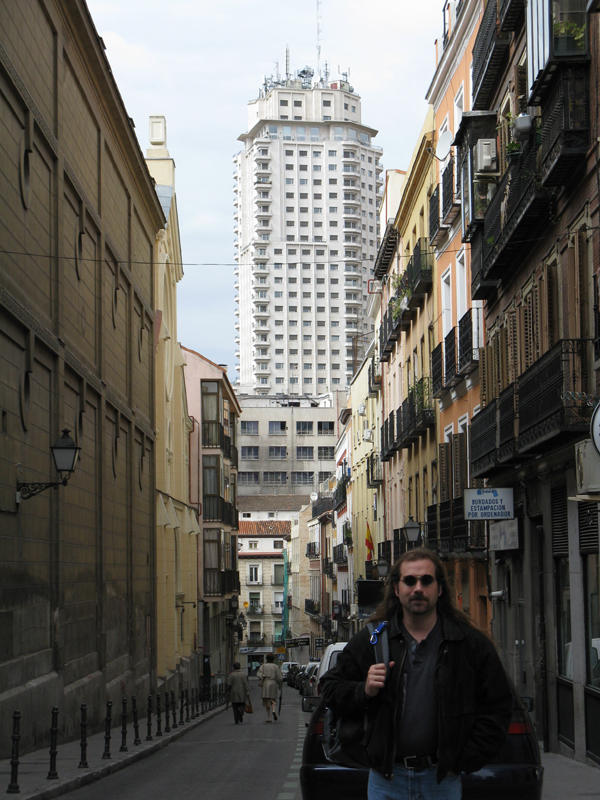
Fomento Street and Paco/Puck
The unused church is the yellowish building on Puck’s left and behind him, and if you look carefully you’ll see a red and yellow flag on the right-hand side of the road. That is where the police station is. Our apartment complex is on the left-hand side of the road across from the police station. The road is narrow with small sidewalks protected by metal bars, and traffic is one way. You can see the many balconies looking onto the street where people often have their clothing hanging out to dry and plants. People sometimes come out to watch the street below as well, and there are usually 2-4 cops standing outside the station talking. We saw them dusting a car for prints out by the side of the road one day on our way home.
There is a little restaurant near the other far end of the road where the local older men gather and play cards all day. You can hear them arguing and chatting whenever you pass in the street. Tuesday night Puck and I decided to eat dinner there, and the people were very nice. It is run by some Bolivians who make empanadas (meat dumplings? basically, meat, spices, and veggies, etc. baked in a crust) like the ones I loved in Argentina. They were getting ready to close, but they welcomed us in and fed us.
There is a cafe next to the police station that is open weekdays, and the fellow who works there is always very friendly to us when we go in. Also, in the background you can see a tall tower–the Tower of Madrid–which is on the other side of the Plaza de Espana (Spain Plaza). One of our favorite restaurants is a Chinese restaurant that is actually under the plaza. They have the best noodles!
The Rastro
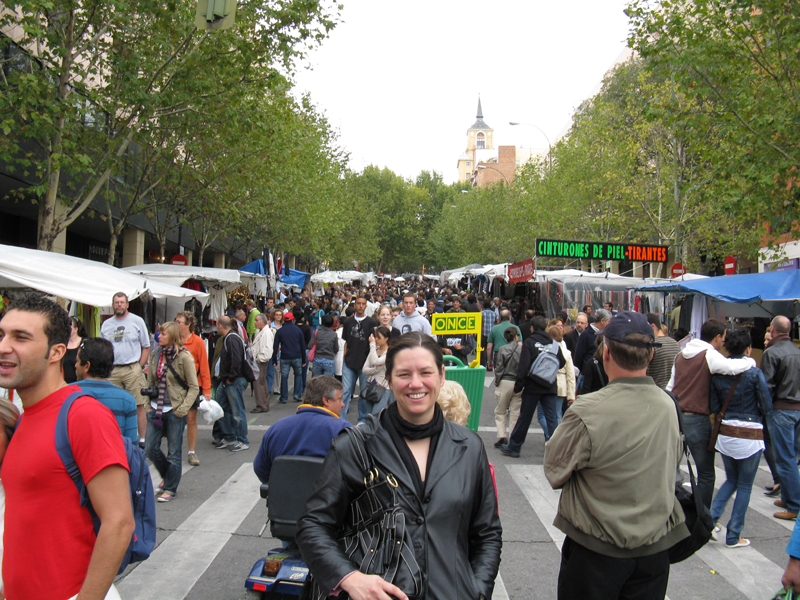
Every Sunday this market is full of vendors and people.
This is a weekly open-air market (9 AM until 3 PM Sunday) in Madrid. It is a good place to find items for good prices, and you can often haggle if that is your cup of tea. There is always a mass of people though, and you have to watch for pickpockets. I have my new purse in the photo which I bought at the market. It’s big and roomy which allows me to carry a book to ready on the metro, an umbrella, our small camera, my notebook and misc. other items. It’s been very handy.
Domingo’s Cafe
These next two photos are from the terrace outside one of our favorite cafes–Domingo’s which is located by the Santo Domingo Plaza.
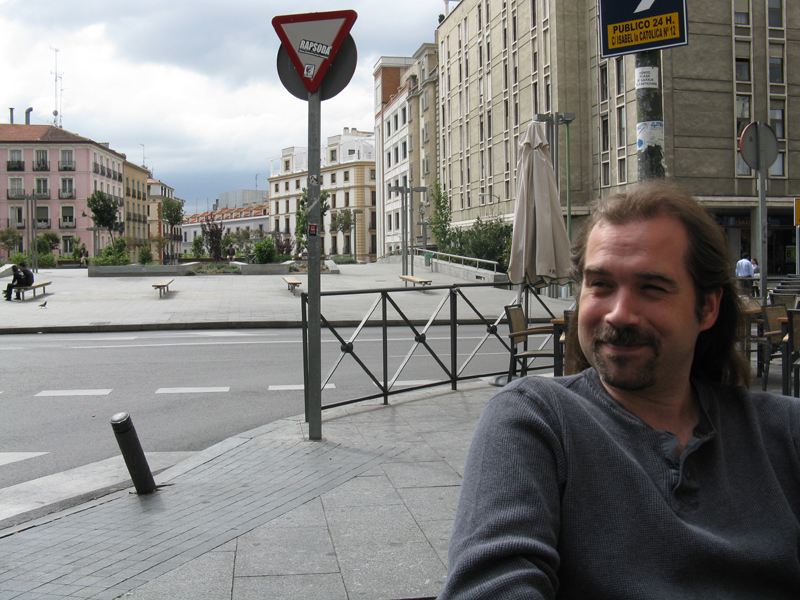
You can see part of the plaza behind and to the left of Puck, but it also goes down the hill and has a small playground for children.
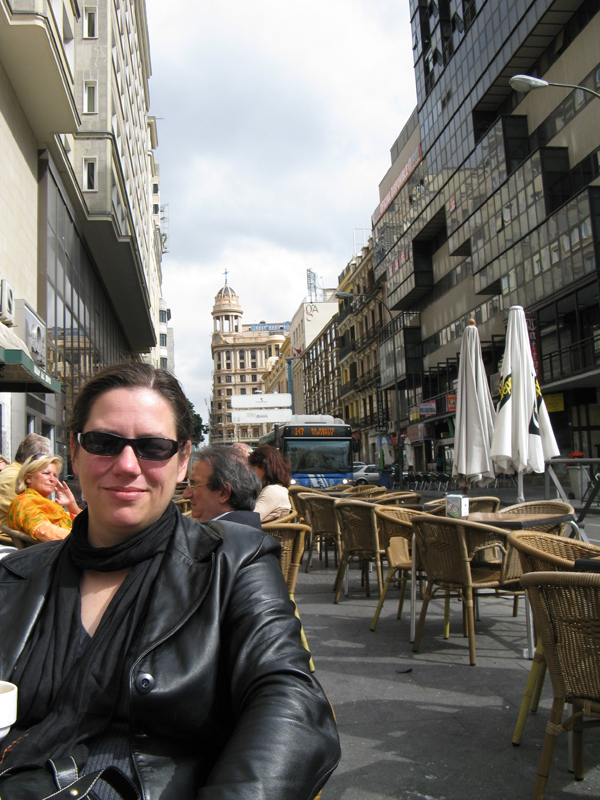
The street behind me stretches to Callao, and you should always rememer to look up. The rooftops often have decorative surprises.
It is pretty common for us to pass this plaza on our way to one of the main shopping areas near us (and a tourist area) called Sol Plaza (Sun Plaza). It has some of the big chain stores, and if we can’t find what we need in the small “bazares” or “alimentaciones” (which are often called “chinos” here because they are typically run by Chinese immigrants), we can find it at these large stores. The waiters at Domingo’s are very nice, and there is one in particular who occasionally spoils us with a free dessert or two. I think it might be because we usually leave a tip. Tipping isn’t as common here as in the states, and the tips are usually much smaller than back home. Leaving 1 euro is generally a big tip for a meal. As another note, the restaurants and cafes often have different prices for their terrace, tables and bar–with the bar being the cheapest and the terrace seating the most expensive.