Written and posted today! Whew! I’ve been adding blog posts for the first few months here, and it was a rather big project. Still, I did it for me and to share with friends and family who might be interested and who weren’t on my e-mail list. As I finished it up I realized that I haven’t been writing update e-mails home since Puck flew back to the US. I have talked with family by phone a bit more, and I IM or chat with Puck almost every day.
The recent economic crisis has affected Spain significantly, and unfortunately the country has severely restricted giving work visas to foreigners. What does this mean for us? Puck’s company couldn’t get his work visa, so our current plan is for him to spend alternating three months in the United States and Spain with tourist visas.
I’ve been spending time at the Royal Academy of History’s Library lately, and on November 20th, I went to a concert to celebrate Fulbright’s 50th anniversary in Spain. Current and past Fulbrighters performed–playing guitar, violin, cello, piano, and other instruments as well as singing. I had never fully appreciated the range of expression of a violin before, and I enjoyed all of the performances.
On November 25th, I went to the second reunion of the cultural history colloquium at the UAM. There was a large group to hear Bryann Hamann’s comparative history presentation based on two trials–one in Valencia and another in New Spain.
With Puck’s busy schedule as he studies for his fencing exam this month, we rarely have much time to chat, so for Thanksgiving, Puck and I rented the same movie and hung out together online. It was nice to have several hours.
Kind of funny though. It’s a post titled “today,” but it is still dealing with the past as much as the present.
What is a Fulbright? That was often the question from people when they heard about my grant to do my dissertation research in Spain.
There is the official answer.
The Fulbright Program was started in 1946, and its name comes from the Arkansas senator J. William Fulbright who introduced the bill in September of 1945. The date is important. It is the same month that World War II ended. The objective of the Fulbright Program is to promote international understanding and cooperation, and its grants support coursework, research and teaching of approximately 1500 students each year in over 155 countries. According to its government website (http://fulbright.state.gov/), “Fulbright is the most widely recognized and prestigious international exchange program in the world.”
This is the 50th anniversary of the program in Spain, and they are proud of its growth over the years. While initially the United States funded scholars in Spain, that is no longer true, and Spain is hosting 22 researchers this year and a large number teaching assistants. The Fulbright Committee in Spain encourages community involvement and supports those who have come to study and teach.
What was the process?
For me, the process started by receiving an e-mail and choosing to attend an informational lecture about the Fulbright Program at UC Davis. Then, during the summer and fall of 2007 I worked on my application for a Fulbright research grant and a Program for Cultural Cooperation (PCC) scholarship to do my dissertation research in Spain. This involved many of the typical application requirements–recommendation letters, a language evaluation, academic information and transcripts. I also wrote and translated a proposal and personal statement, and I had to set up contacts in the host country with people with whom I could work and obtain letters of affiliation from them. It was a long process, and in September there were interviews with a committee on our campus who also provided advice. I was fortunate to have had the help of many people throughout the application process–writing letters, evaluating my language skills, revising my proposals, and helping me polish the language in English and Spanish. I am thankful for how their support strengthened my application.
In April, I received the news that I had received the grant. While Puck and I had already been trying to plan for the eventualities, suddenly our life was set on a determined path for the next year–passports, visas, storage unit, packing, plane tickets, and travel plans. Before applying I had spoken with my parents about taking in our Great Dane Shakti for the year. We knew she would be horribly spoiled and well cared for with them. There were many uncertainties in preparations, and the Visa process can be a bit stressful. Still, we took pleasure in each step forward, and I was lucky to have a supportive husband willing to go on this adventure with me even though he’s never had a Spanish class.
Our trip to Spain included a number of our friends helping us with plans, packing and storage, and our dear friend Cindy flew out to make the road trip to Oklahoma with us–with a short detour to see the Grand Canyon. We also had two weeks in Oklahoma to visit family before flying to Spain, and that flight was just another beginning.
What does the Fulbright mean to me?
I recently attended a concert in which past and current Fulbrighters performed to celebrate the 50th anniversary of the program here in Spain. During the ceremonies, the coordinator Grover Wilkins spoke movingly of his Fulbright experiences, of the trust that they place in those selected to pursue their interests and forge connections while also giving them the flexibility to grow in unexpected ways. It is a trust, and I am honored to be among those selected. The Fulbright provides me the opportunity to spend hours and days in libraries and archives in Spain, to train with fencers in Madrid, to live in another country, to share these experiences with my husband, and to meet academics, fencers and others during this year. I can’t fully capture what the Fulbright means to me, but I will share some of it here on this blog by writing about my experiences.
Today, I got my official student visa card. WooHoo! I also went to the BRAH (The abbreviation for the Royal Academy of History’s Library). I only looked at two items this morning, but it was still pretty cool. I also chatted with another researcher there–Natalia–as we were both leaving. She was very nice. She did her dissertation last year on written culture in early modern Seville and said she would check what she had to see if there was anything related to what I’m researching.
I have chosen this category title because my research into Spain’s early modern swordplay focuses on the relationship between the practice of and the literature written about fencing–arms and letters. It is also a reference to the cultured image of the warrior-poet who can wield both a sword and a plume.
The presidential elections in the United States have been discussed on the news, in newspapers, and on the street here in Spain. There were three large election parties in Madrid last night–the Democratic one was the largest, but I only passed by that one. It was very crowded.
The second largest was held by the embassy, and I went to it. It was held in a large building called the Casa de America (House of America) on Madrid’s most famous street–the Paseo del Prado–which also runs by the Prado Museum and a number of other museums and libraries like the National Library where I’ve been doing some of my research.
On my way there on the metro, I met another American–Holli from San Diego who has been living in Spain for 10 years. She decided to accompany me to the gathering, and we had a good evening together.
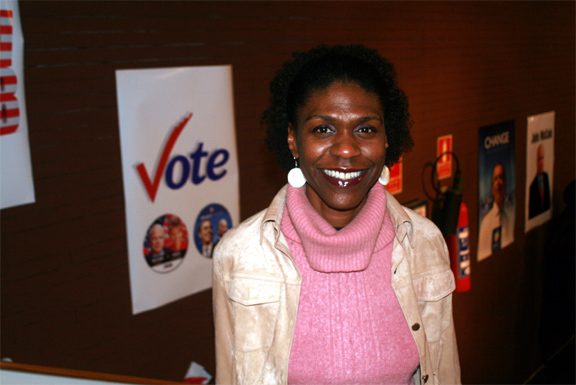
Holli near the stairs down into the main area. I like the vote sign!
There were supporters of both McCain and Obama there. When we entered they gave us 3 pins–1 with McCain and Palin, 1 with Obama and Biden, and 1 with the Spanish and American flags crossed. They also gave us unofficial ballots to cast. 🙂
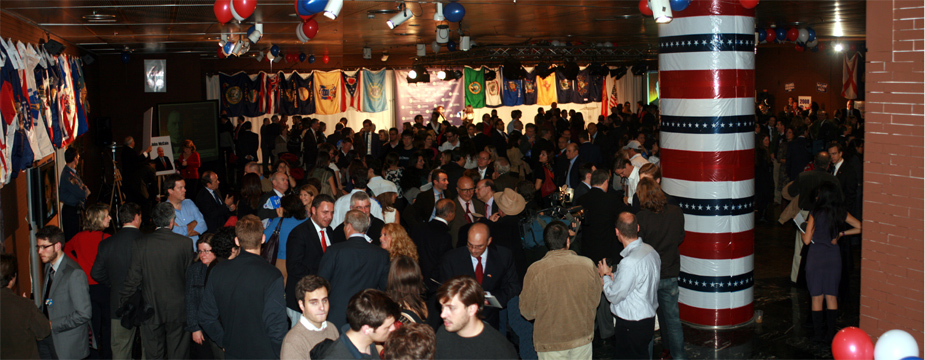
There was a large crowd downstairs and lots of flags.
The US ambassador to Spain Eduardo Aguirre spoke, and he has a strong Texan accent in English and a Cuban accent in Spanish. He was born in Cuba and immigrated to the USA when he was a teenager.
I had a chance to get a photo with “Obama” on election night.
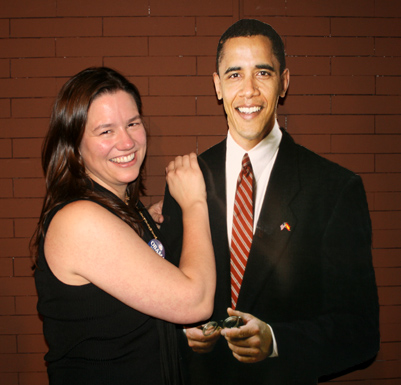
Isn't he handsome? Though he's a bit thinner and shorter than I expected. 🙂
Holli and I had a good time, but they weren’t keeping us well-updated on the election results. Around 3 AM, we headed for home, but we stopped to take a fun photo with a couple of other guests from the party who had some masks with the candidates’ faces on them.
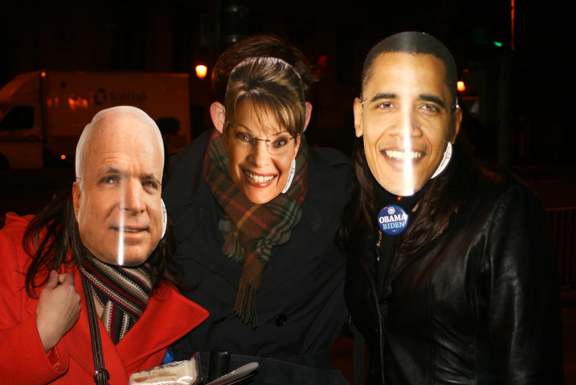
Do I make a good Obama? I love the ears on Palin and the long hair on McCain!
After getting home, I chatted over Skype with Puck in California, my brother-in-law Robert in Australia, and our friend Johnnie in Texas–with some IMing with our friend Cindy in Indiana, calls from Johnnie’s grandmother in Oklahoma, and a call to Grandma and Papa after Obama’s speech. It is amazing how connected the Internet allows us to be. I was up until 7 AM Madrid time, but it was worth it. It’s a momentous moment for the United States.