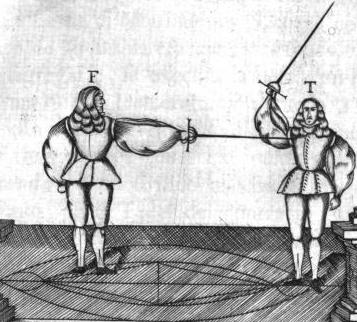
The classical dialogue that Jeronimo Sanchez de Carranza created takes place in the summer of 1569 in the house of the duke of Medina-Sidonia. The characters are making jokes, telling stories, and talking about good fencing, bad fencing, and how to teach fencing. What Carranza describes is intimately familiar to anyone who fences and by that I mean a collection of friends gather together to share fellowship and talk about swordplay with food and drinks over a friendly weekend.
450 Years of Tradition
Some of the treasured moments of my life take place in a backyard or at a kitchen table with good friends doing exactly this.
When you consider a person like Carranza you need to understand that he was not a fencing master but rather someone in search of the truth of martial arts and he strongly believed that within this truth was a process that human beings could use to grow, seek knowledge, and make the world a better place through learning and training. Any one of us, regardless of our experience or title, has the potential to be Carrancine when we strive towards the martial truth, when we seek to become better, when we work to improve the world around us.
This year is the 450th anniversary of the summer of 1569 in which La Verdadera Destreza was born. In conjunction with the Chicago Swordplay Guild the Sacramento Sword School has been planning a grand celebration hosted at the Western Martial Arts Workshop in September of 2019. I don’t want to spoil the surprises that the CSG team has in store but I will say that if you are a diestro and you love the martial traditions of Iberia, you are welcome and you will find plenty of opportunities to learn, train, and fence.
What follows is the basis for the Golden Mean in philosophy and how it relates to Destreza. (If you want to find the practical application, you can skip to the end.) First, we should define the Golden Mean and we can start with a simple analogy.
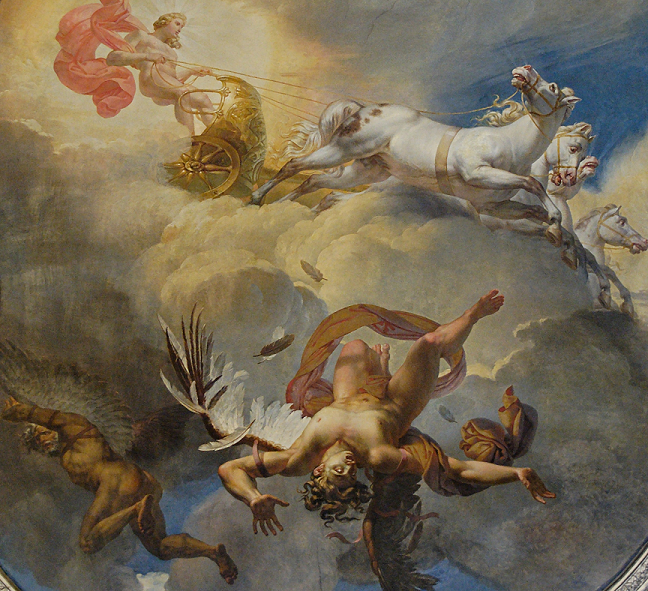
Icarus flies with artificial waxen wings. If he flies too high the wax melts and he plummets into the sea. If he flies too low, the splashing water will weigh down his wings and he will, again, plummet into the sea. Only by flying the middle path will Icarus be safe.
Icarus falling (Merry-Joseph Blondel)
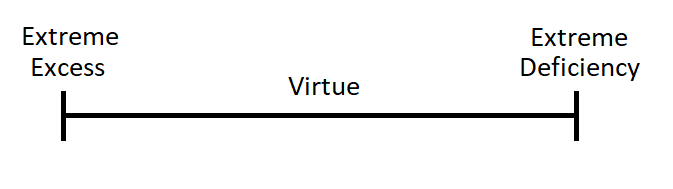
In the same way, Aristotle’s Golden Mean (or the medios) are virtues which exist as mindfully chosen points between two extremes. Aristotle lays this theory out in Nicomachean Ethics as a balance between excess and deficiency. Another key point is that medios are chosen mindfully and with consideration rather than as a habit or a natural response. (As an example, good manners are considered rather than pro forma.)
The medio pattern for the virtues is:
Between two extremes a virtue can be mindfully chosen
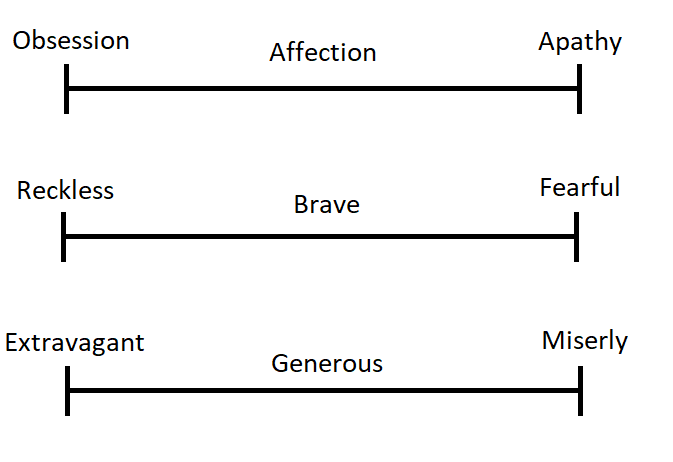
Here are some examples:
Medios choose between too much and too little to find a balance
Maybe you agree with this formation of ethics and maybe you don’t but knowing this will help you understand True School Destreza. One of the critical phrases you will see in True School Destreza is “not participating in extremes”. This is an essential clue that we are talking about a medio and the tradition has plenty of them. (When I use a lowercase ‘m’ I’m referring to a general golden medio and not one of the Named Medios which will be uppercase ‘M’.)
Let’s consider some examples of medios in the tradition:
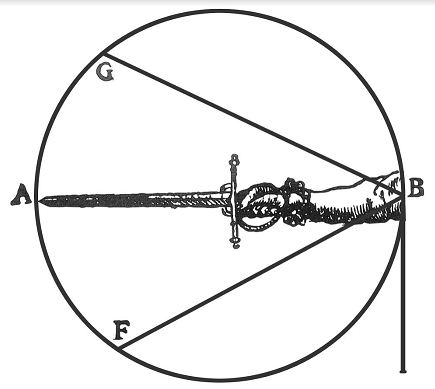
The Right Angle
Between the obtuse angle (GB) and the acute angle (FB), lies the right angle (AB).
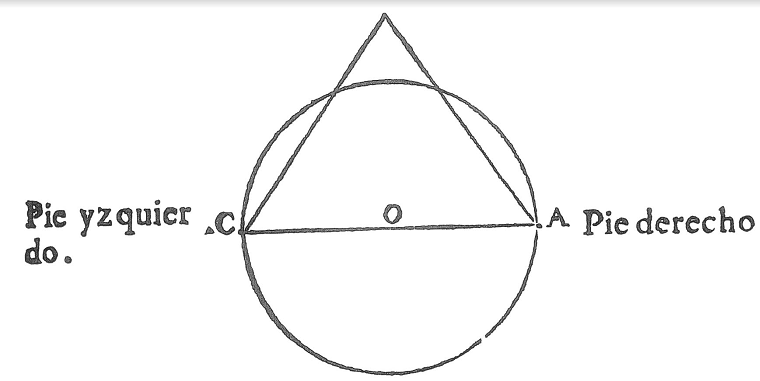
Center-weighting
Rather than resting the weight on the left foot (C) or the right foot (A), center the weight (O).
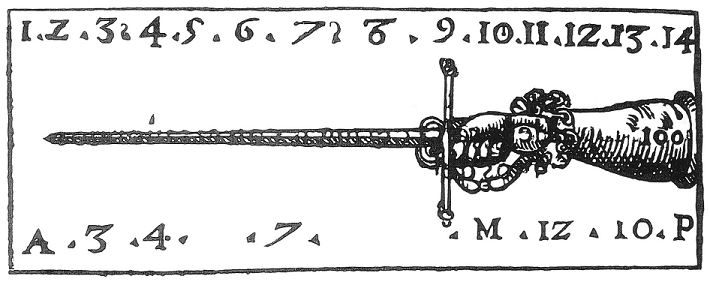
Hand Position
Between the extremes of fingernails up and fingernails down lies fingernails inside.
The Atajo
“Atajo, according to our definition, is when one of the weapons is placed over the other (not in any of its extremes nor with any of its extremes) and with equal or some degree more of strength subjects it and makes it so that the technique that can be formed must be done with more movements and the participation of more angles than those that its simple nature requires.”
~Pacheco’s New Science as translated by Mary Curtis (p.365)
Choosing Medios
Now we know what medios are but as to choosing well, how do we do that?
For that, I think we should consider Carranza and the role of Eudemio in the Carranza text. He is a young man excited about fencing but his mind is filled with many false notions. Through dialogue the other speakers persuade him into a process of action, an algorithm for true Destreza which Carranza outlines.
Consider this passage of Charilao’s in Carranza’s text:
What the aim of the Destreza is:
“Because the Swordsman should first know and after having known to fabricate in the understanding with the declared parts what he should do against the adversary which is the goal in the art of defense, and afterward to look for the means that are best to achieve the intention, because what is first in the intention is the last in the execution of the demonstration, and this is understood in the swordsman who acts with deliberation for some purpose, which is not required in the purely natural agents because the action of these is that of nature: so the demonstration is divided by cause and by effect.”
~Carranza as translated by Mary Curtis (folio 35r)
If there was ever a purer statement of LVD I have yet to find it.
To summarize:
Knowledge – To know you must learn, you must study, understand, gain experience
Perception – Understand the potential, see the possibilities, the paths forward
Decision – From these possible futures choose the best
Action – Bring the decision into reality through action
Carranza directly tells us that his book is intended to improve the young men of Spain. Swordplay is the mechanism he uses to present a method of thoughtful or deliberate action but we shouldn’t be deceived into thinking that he’s only talking about swordplay or even self defense but a path to a beautiful medio or virtue in the Aristotelian sense.
Later, our young protagonist, Eudemio, denounces the false fencing master of the text. At this point in the text he knows the truth because he has learned. He understands the potential paths forward. He makes a decision to tell his friends about the dangers of the false fencing master and he acts.
That’s Destreza. True Destreza, in my opinion, is most correctly the application of this process regardless of the specific system. The books provide us with a traditional system of swordplay that we can try to recreate but behind it all is the pursuit of the truth and the betterment of the world by mindful action.
To paraphrase Carranza each fencer is a musical instrument unique to itself. On each you must tighten some strings and loosen others until the instrument is tuned. Only then will it produce harmony. Fencers have different bodies, different weapons, different spirits, and different contexts. If the causes that form the fight change, the fencing must change as well. That’s expected.
Defensive Medio
More than just a mark on the floor showing distance or measuring swords against each other, the Medio of Proportion (MdP) is a wholistic context in which the diestro gathers up many different causes, processes them using the system above, and then finds the correct place from which he or she can begin to form an offense yet still effectively defend. Balance extremes of offense and defense to find a defensible place to begin forming offense.
Practically Speaking: The simplest advice given here is to set your distance by measuring the swords against each other. The better advice is to set your distance such that you can still effectively defend yourself. If you are bouting and you are routinely struck before you can defend, you are setting up too close. Adjust your distance back until you are able to defend. As you gain experience and skill, you may find that your defensive medio changes.
Offending Medio
The Proportionate Medio (MPado) does the same but guides us in forming the attack such that we are protected. Balance extremes of offense and defense to find a place to strike while defended.
Practically Speaking: A well-formed attack should control either steel or time. If you have the adversary’s threat locked down with a bind, a conclusion, or some other physically detaining action then your attack is safe and achieves beauty. If you control the tempo because your adversary is moving dispositively you may strike in that during tempo of the movement. That’s also beauty. If you manage to provoke a defensive movement from the adversary with the right angle and you strike them with the Apropiado consideration that’s personal artistry and great fencing.
In Conclusion
When we fence and train within our context according to the causes then we may choose our medios well. That virtue is artistry and it creates beauty. When our instrument is in harmony with itself we can create music.
The True School of Destreza is not here to provide simple answers, instead it asks you to think about the context and find the answer yourself. By requiring the diestro to process the causes and choose medios, the diestro becomes an intellectual collaborator in the tradition. Suddenly the responsibility isn’t on the tradition to produce results but on the diestro to use science and skill to find them, to adapt knowledge, to challenge bad ideas, and always to strive towards something greater. Find the medio and you’ve found the truth, even if it is only for a moment.
(Credit to Charles Blair for providing me feedback which helped me correct some of my earlier work and arrive at this better understanding.)
In the last article I described the Spanish True School’s Timing Contexts. (Link)
Here is the table again for reference:
Times and Timings in Spanish True School
Time
Offending Timing
Simple English
Executive\Dispositive
Fencing Context
Before (not in time)
Propio
Get
—
First Intention Action
During (in time)
Apropiado
Give (Given)
Dispositive
Attacks into preparation,
Multi-Intention Attacks
After (possibly in time)
Transferido
Steal (Stolen)
Executive
Parry-Riposte,
Counterattacks
We can easily see these concepts in action by considering the actions of the first two Death Stars.
Propio – The Death Star Attacks Alderaan
Alderaan is at rest and the Death Star strikes in the before time, totally blowing it away with a Propio Medio Proporcionado. It’s evil, but it worked.
Apropiado – The Rebel Fleet Attacks the Death Star at The Battle of Yavin
The Death Star is moving into position to attack and is destroyed while preparing to fire with an Apropiado Medio Proporcionado. You can’t “fire when ready” when you’re dead.
Transferido – During the Attack on the Second Death Star the Death Star Attacks the Rebel Fleet
The attack is underway and the Death Star counterattacks with a Transferido Medio Proporcionado! It’s a Trap!!!
Bonus Transferido – During the Death Star’s counterattack, the Rebels counterattack the counterattack
The Rebels have reversed the Emperor’s Transferido with a Transferido of their own. Yeeee-hawwww!
Do you know how to classify movements as dispositive and executive and the tactical response to each of these two types of movements? (Link)
Do you know the Defensive Medio (ideal defensive place) and the Offending Medio (ideal strike)? (Link)
The temptation on an article of this kind is to present the proof first so that I can explain my reasoning with citations from the texts and an extended discussion about theory. Only after you have worked your way through the proofs do I present the theory. In this case, I’m going to present the fencing theory first and if you want the academic argument and research, it’s included afterwards.
Likewise, this can be a bit much to wrap your head around so the next article will try to lay this out with a very simple (and hopefully amusing) example. (Link)
Striking Times for the Offending Medio (Medio Proporcionado)
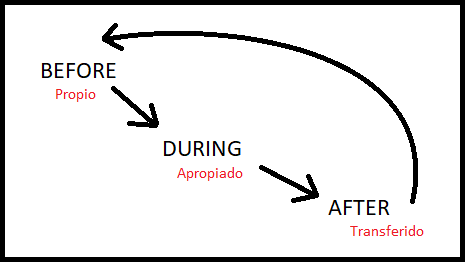
First, we need to know there are three times in La Verdadera Destreza:
Before – The adversary has not moved
During – The adversary is within a dispositive movement
After – The adversary is within an executive movement or has just stopped moving
Because terms like “Before” and “After” are relative, they can also be used ambiguously in the same way that big and small are used. This provides them more utility but can be confusing unless you know what they are specifically being related with. For example, I am big compared to a mouse but small when compared to my car. The terms gain meaning depending on what you compare them with and this is most often movements of the sword and footwork.
You may see Before, During, and After used in relation to a complete technique like a beat to the sword. (Before the beat, after the beat…)
You may see Before, During, and After used to describe movements inside a technique which has been decomposed into its pieces. (During the adversary’s offline movement which prepares the beat, before the final movement of the thrust which follows.)
Timings for the Offending Medio
Pacheco describes these timings as ways to describe your Offending Medio (Proportionate Medio or Medio Proporcionado [MPado]). The Offending Medio is achieved when you offend successfully while defending.
Propio – In the before tempo the deistro gets an opportunity for himself. (To strike in the adversary’s stillness.)
Apropiado – In the during tempo the adversary gives, by movements of the sword or by footwork, an opportunity for the diestro. (The adversary gives, by their movement, an opportunity.)
Transferido – In the after tempo, the adversary attempts to seize an opportunity, but it is taken from him and transferred to the diestro. (To take the outcome the adversary sought, and transfer it to yourself.)
Times and Timings in Spanish True School
Time
Offending Timing
Simple English
Executive\Dispositive
Fencing Context
Before (not in time)
Propio
Get
—
First Intention Action
During (in time)
Apropiado
Give (Given)
Dispositive
Attacks into preparation,
Multi-Intention Attacks
After (possibly in time)
Transferido
Steal (Stolen)
Executive
Parry-Riposte,
Counterattacks
Examples:
Propio : The adversary is at rest. Before he moves, the diestro strikes him in first intention. The diestro gets the opportunity (disposition) to strike before any movement occurs.
The diestro covers the blade with an atajo, moves forward and strikes with a thrust.
Seeing the adversary’s resting guard places his blade is out of line, the diestro strikes immediately before the adversary can move.
Apropiado : The adversary is in motion carrying the weapon off the path to the target. During the motion, the diestro stikes him in the same time. The diestro was given an opportunity to strike by the adversary’s dispositive movement.
The adversary attempts to elude an atajo by lifting the point. During the violent movement (rising) the diestro strikes with a thrust in the same time. (in time)
The adversary attempts to parry a thrust with an atajo on the inside line. During the offline movement of the atajo the diestro redirects the thrust to the chest into a clockwise circular thrust to the flank. (half circular thrust in second intention)
Transferido: The adversary was attempting to strike and during the final movement of the attack was defeated and struck. The diestro has stolen the enemy’s opportunity and transferred it to himself.
The adversary executes a thrust. The diestro defeats the thrust with an atajo and responds with a thrust to the chest. (parry-riposte)
The adversary executes a thrust. The diestro defeats the thrust by stepping offline, presenting the right angle, and the adversary is struck in the same time. (counterattack)
But wait… there’s more!
Ettenhard expands the scope to more than just attacks. He applies these relative timings to more contexts such as finding Medio de Proporcion (Defensive Medio) and gaining strength in the bind. That liberates the concept of attack, attack in time, parry-riposte from solely the attacking realm into broader conceptual space.
We can speak now of taking good measure, being given good measure, and stealing good measure with counter-footwork.
We can take the bind, be given the bind, or steal the bind with counter-bladework.
Citations
All translations are the work of Dr. Mary Curtis.
Definition
Three considerations that they make, in agreement with the art, about the proportionate measure [MPado], which we call Propio, Apropiado, and Transferido.
Presupposing the knowledge that we have given about the proportionate measures [MPados] for all the species of techniques, it is advisable for he who wants to enjoy the perfection of skill, to know the three considerations (more important than extolled) that we make of them (without altering their essence) calling them Propio, Apropiado, and Transferido, and for its definition we said of the first, it is the one that the swordsman chooses for himself, without the opponent doing more than wait for him, which we call before time; of the second, it is the one that he offers him by means of his movements and steps, which we call in time; and the last, the one that when he goes to choose it or has chosen it, and the execution differs, it is taken from him, and chooses for himself; and this is characterized in time and after time;…
Pacheco’s New Science pp.287-288
Applied to striking in time (Medio Proporcionado):
And finally, if he wants to escape from the subjection, freeing the Sword, to strike with a Thrust, from the outside, it should be necessary for him to make a Circular action, that consists of four simple types of Movement, making a Mixed one of all four, by whose cause it is without a doubt the opposition of the Offline Lateral Movement, striking in reason of the Right Angle, with which it is undoubtable that in all these situations it is made, that by means of Atajo the opponent offers Apropiado Proportionate Measure; since taking advantage of the Movements that he forms, one takes advantage of the opportunity to strike,…
~Ettenhard’s Compendium folio 146-147
(The act of taking atajo requires taking your point off the line which is a dispositive movement that can grant the adversary the opportunity to strike. Or restated, the Offline Lateral movement of the atajo can grant Medio Proporcionado Apropriado… the attack executed in a during time.)
Applied to footwork\place:
It should also be understood that if the two Combatants find themselves with equal Arms, the one who first chooses the Measure does it for both, and it is called the Propio and Apropiado Mean of Proportion because the Swordsman at the same time takes the Measure for himself and offers the same disposition to his opponent; but if either of the two brings a longer Sword and he chooses the Measure in the way that has been said it is called the Propio Measure of Proportion due to the Election being for him alone, the other being disproportionate: And if the one who brings the shorter Sword has his tip at the opposing guard it is called the Apropiado Measure of Proportion…
~Ettenhard’s Compendium folio 71
Applied to degrees of strength in the bind:
…and thus one should understand the same (in the execution of these Movements) that in the way of choosing the measure of Proportion, it is warned, making difference of when the Swordsman chooses it for himself, or when it is offered chosen to the opponent, saying to the one Propio and to the other Apropiado; since the Propio Movement of increase that the Swordsman makes, offers to the opponent the one of Apropiado decrease: and the one of Propio decrease, gives Apropiado to the opponent the one of increase.
~Ettenhard’s Compendium folio 120-121
By taking a degree of strength in the bind in first intention (Propio) you also give weakness to the adversary (Apropiado). If you weaken yourself in the bind (Propio) you strengthen your adversary (Apropiado).
In La VerdaderaDestreza, Movements are vectors which describe the motion of the sword (or sword arm) in a direction. You can read about these movements in my previous article here.
The Weapon can move in 3 dimensions
To go further we need to classify movements into two groups.
An Executive Movement is a vector of the weapon with the potential to deliver a wound either by thrust or cut.
A Dispositive movement is a vector of the weapon which does not deliver the final wound. This may be a preparation strike, a defensive movement, or even wasted movements
Executive Movements:
Forward
Natural (downward)
Aligning Lateral
The forward movement of the weapon is an attacking movement, or an Executive movement
Dispositive Movements
Backwards
Offline Lateral
Violent (rising)
Chambering a cut may prepare an attack but it is not the final movement of an attack. A non-attacking movement (even a preparation) is a Dispositive movement
Note: Without too much effort you can imagine instances in which a rising movement might be executive (rising cut) and a natural movement might be dispositive (atajo). More on this later.
Application
By decomposing a fencing phrase into its movements we gain insight into both the fencing tempi and the role of each movement. Here is an example fencing phrase broken down by movements:
The Master executes Atajo and thrust by detachment:
1.
Violent (rising) mixed with Offline Lateral to cross the opposing sword on the inside line
Dispositive
2.
Natural (downward) to subject the opposing steel
Dispositive
3.
Aligning into presence mixed with Forward to deliver the thrust
Executive
The student parries and ripostes by half reverse:
1.
Natural mixed with Offline to subject the opposing steel downwards on the inside line
Dispositive
2.
Aligning mixed with Forward to deliver the half reverse to the right eye
Executive
Opposing the Enemy’s Movements with Movements
In his book (Treatise 3, Ch.3) on the opposition of Movements Ettenhard plainly describes the tactical solution to each movement committed by the adversary:
Movement
Type
Counter
Movement
Violent (rising)
Dispositive
Forward (Right Angle)
Offline Lateral
Dispositive
Forward (Right Angle)
Backward
Dispositive
Forward (Right Angle)
Forward
Executive
Natural (Atajo)
Aligning Lateral
Executive
Natural (Atajo)
Natural
Executive
Natural (Atajo)
The Forward movement which presents right angle or the thrust opposes all the Dispositive movements:
With which I say that this is the one [Forward Movement] that is opposed to all because since it is worked in reason of the Right Angle it has the preeminence of the greatest reach, moving in correspondence to the nearest Point of Contact, where one should constitute the strike in the opponent…
~Ettenhard (translated by Dr. Mary Curtis)
The Natural movement which subjects enemy attacks downward opposes all the executive movements (from which the strikes are composed):
To the Dispositive Movements, the Executives follow, whose opposition is different due to having to make it with an engagement of the Sword and the other of free cause: in a way that the Forward Movement, that of Aligning Lateral and the Natural (which are the ones that by nature form the strikes) are destroyed and opposed to the Natural by its greater speed, strength, and reality…
~Ettenhard (translated by Dr. Mary Curtis)
Simplest Form:
Adversary presents Dispositive Movement, Right Angle
Adversary presents Executive Movement, Atajo
When the adversary presents a dispositive movement, the defender answers with a thrust in time.
What Ettenhard describes lines up nicely with Pacheco’s counters to vulgars. Pacheco’s process of analysis decomposes a treta into simple movements and then his counters largely align with Ettenhard’s oppositions described above with additional options and details. With this principle in place you can decompose any technique of the adversary and apply counters movement by movement.
It is also essential in understanding the True School’s usage of timing contexts to describe attacks in first intention, attacks in time, and attacks which transfer the adversary’s attack to you.