Another anniversary…
Memories…
Moments…
Music wafting over the university lawns…
A first date–bagels, music, talking late into the night…
Snuggling on a couch…
Joining hands, hearts and lives…
A puppy coming home in the snow…
Snowed in with friends…
Thanksgiving dinners with family and friends…
Yummy Thai, curry, Indian, pizza, Chinese, cheesecake, flan…
Books, games, videogames, swords, cards, music, movies…
Traveling together across the miles and the years…
Adventures, friends, family, photos…
Together…
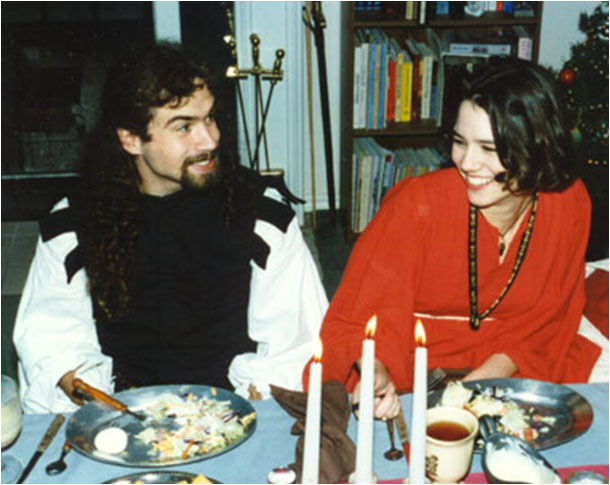
Young love and a holiday dinner
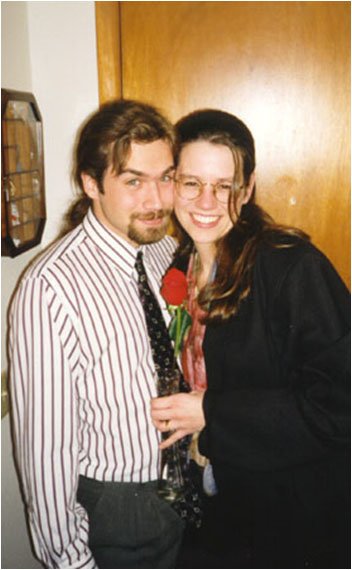
A ring and a promise
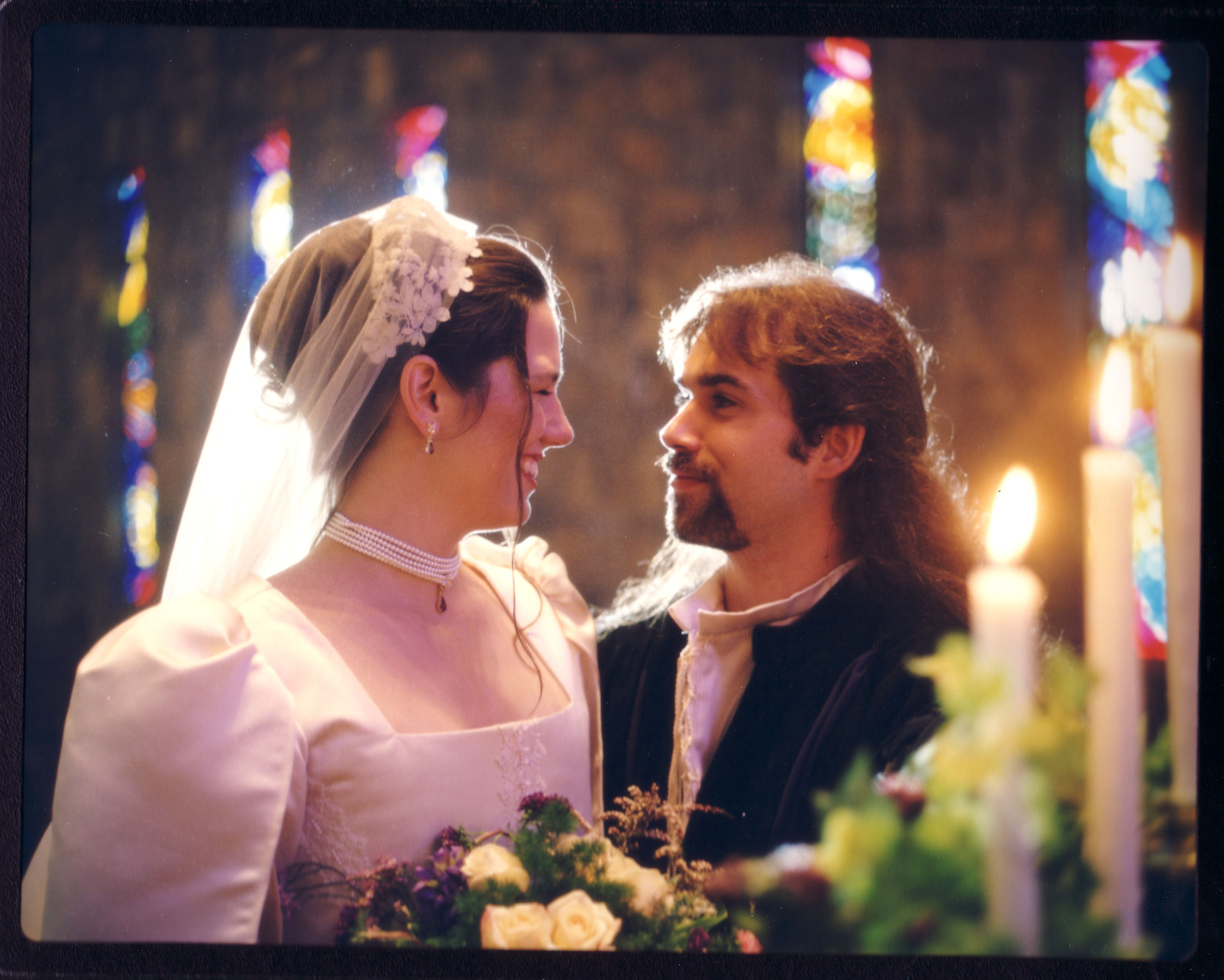
A day for love, surrounded by those we love
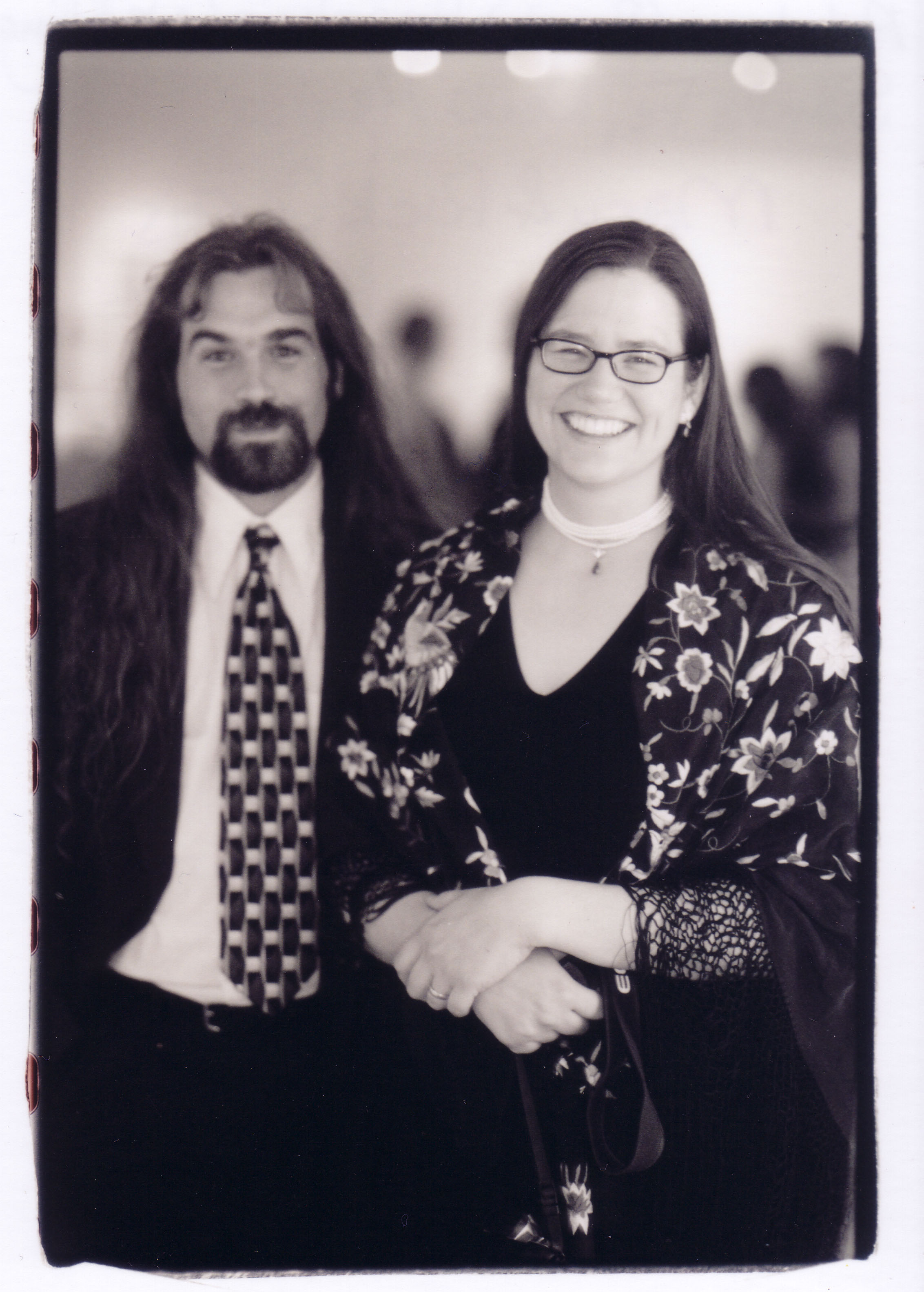
A lovely day in New Mexico
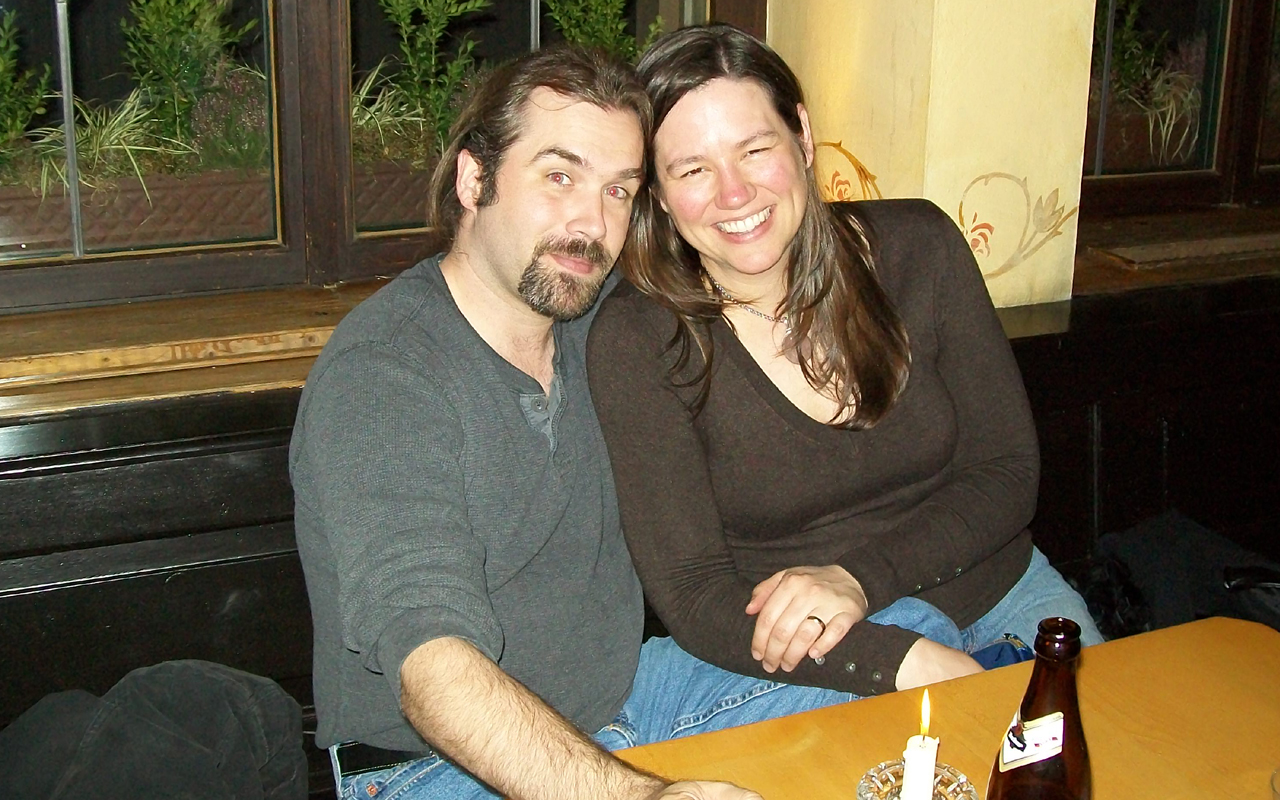
A rendezvous in Germany
And so much more to come…
Lately my little apartment in Madrid has been a bit like Grand Central Station. My sister Janet and her husband Montie arrived a couple of weeks ago, and I’ve enjoyed every moment I got to spend with them during their vacation in Spain as well as the video chats with their two darling girls who cottoned onto using Skype right away. My cousin Regina and her friend Joe arrived Wednesday, and they are currently driving through a few Spanish towns. Today was a big day for me as Puck came back to visit (and work) for five weeks and Janet and Montie headed home.
How is it that I am a 100 pounds lighter? Well, having Puck back in my arms definitely makes me feel so (WooHoo!), plus Janet and Montie were generous enough to take two suitcases worth of stuff home for me–filled with 100 pounds of winter clothes, books, and newspapers (mostly with election articles). Wow! As the date for my return to the States approaches, it is a definite relief to have so much already on its way there, leaving room for all my other things…hmmm…and maybe I can buy more books?
(Due to heavy spam on this post, comments are currently blocked on it.)
On my recent 5-day trip to Seville, I visited 4 archives and a library. That’s a rather high number, but I was doing some targeted searches for documents as well as familiarizing myself with the archives. I will be making another trip down to Seville this upcoming month. My routine was fairly regular: Every morning, I would head off to an archive until 2 or 3 when they would close. After lunch, I would head to one of the two places open in the afternoon until 7:30. It was a whirlwind experience but useful. Here are some of my impressions of the places I visited:
Archivo Histórico Provincial (Provincial Historical Archive)
This archive is located in the winding streets of the older section of Seville, and each morning I would head out from my hostal and launch myself toward the archive. While the map helped to track where I was, I seemed to do better (for the most part) by just heading in a general direction, especially since the streets were a maze with names that change every block or two. It took me from 15-30 minutes to wind my way to the this archive and the Municipal Historical Archive that was right next door. The building was relatively modern. However, it was difficult to find the archive and its location on the Internet, and I was fortunate to have information about specific documents I wanted to see as the content was not easily accessible through indexes or databases. I did have the opportunity to flip through bound documents from the sixteenth and seventeenth centuries though.
Archivo Histórico Municipal (Municipal Historical Archive)
The municipal archive was also pretty modern, though its microfilm readers were rather old. Much of the content I looked at here was on microfilm, and they had indexes to assist in searching for specific content. The staff was very friendly and helpful.
Archivo Arzobispal (Archbishop’s Archive)
While I was unable to locate the document I searched for at this archive, the building was incredible. The archive is inside the Archbishop’s Palace which is right next to Seville’s Cathedral. On entering, my bags were scanned by a security guard before I was sent out into a patio area covered by cloth to keep away the searing Seville sun and back toward a garden with a fountain and statue. With the windows of the archive looking out on the garden, it felt like a magical secret archive. The information here was indexed to a certain degree, but it was not yet easily searchable for specific content.
Biblioteca Capitular y Colombina (Cathedral and Columbus Library)
This library has an interesting history and location. Christopher Columbus’ son Hernando assembled a large collection of Renaissance texts from across Europse in the first half of the 16th century, and while many of these have been lost over the centuries, his collection forms the basis of this part of the library. The Cathedral’s library contains a wide-range of texts, many donated to the Cathedral from private collections over the centuries.
Finding the library was a bit of a trick. You have to spot the right door in the Cathedral’s wall (it has a sign that says Columbus Institute above it) and then find the buzzer that is almost hidden by part of the door. However, once you have gained entrance, the staff here is very helpful and friendly, especially the fellow who assisted me the first day and familiarized me with the library. The hallways and rooms are spacious, and the windows by the researchers look onto the Cathedral’s famous patio of orange trees. As for ease of access, Hernando Columbus’s collection is searchable through a database, and there are two catalogues for the rest of the library’s manuscript and printed holdings. Most of the texts have been microfilmed to protect them as well. Overall, a very pleasant experience.
Archivo General de las Indias (General Archive of the Indies)
This famous archive is only a short walk from the Cathedral, and it contains tens of thousands of documents related to Spanish colonization. Only 15% of its holdings are searchable online, but it has an on-site database to assist in searching the other 85%. The Archive of the Indies has also made a major effort to digitize its documents and provide access to them online. Security was fairly high, though my bags weren’t scanned. Still, there were security guards and cameras to try and make sure visitors didn’t leave with any of the valuable documents belonging to the Archive. I look forward to spending more time at this archive in the coming months (and not just because its air conditioning was extremely welcome), and I am impressed by their efforts to make their holdings accessible to the public.
Every archive and library here seems to have its own challenges and opportunities. The variations in searchability, security and location making each one a unique experience. Though it was a busy week, it was productive, and I have yet more information through which to sift as well as copies of documents to pick up on my next trip to Seville.
It’s been a very long time since I last posted, but here I am again. I will try to add some posts about the last few months. I have a couple started and other stories I would love to share.
Today I made my way down to Seville, and it is both lovely and strange to walk its streets again. The 6-hour bus trip down was relatively pleasant, though I must remember to try to get a seat on the opposite side of the bus from the sun. The temperature went up 10 degrees Celsius (around 18 degrees Fahrenheit) as we headed south.
It took me around an hour to meander from the bus station to my hostal, in part because I had to wander the winding streets of the old quarter between the University of Seville and the Cathedral with its famous Giralda tower. Fortunately, the walk took me along the river, past the Triana bridge that I crossed every day when I studied in Seville for 6 months in 1996 (I’m very fond of that bridge). Then, I went past the bullfighting ring and later came to the Torre de Oro (Golden Tower), another monument I hold dear from my time here, and then away from the Guadalquivir River to the university.
After settling into the hostal (they found a bed for me even though they didn’t get the reservation I had made online), I went back out to wander as night fell. My hostal is just a block from the university and two blocks from the cathedral.
It invokes a strange type of nostalgia to walk these streets again. Seville has added an above ground metro since I was here, but so many places took me back thirteen years to when I studied here, to memories of exploring the city with my parents, my sisters and Puck. So familiar, yet different. Just as the city is a mixture of past and present, my experience blends moments from my personal past with the present…. Coffee with Puck and Dad, photos at the Golden Tower with my sisters, drinks by the river, sitting outside the university with friends and chatting, Puck and Linda chasing down two pickpockets, photos with pigeons…. so many memories.
I also managed to arrive during a week-long book fair. What luck! 🙂 I got to see a few of the stalls tonight before they shut down for the night. Near one of the cathedral entrances the soothing notes of a violinist drew a crowd, and while the day was hot, the evening was invitingly cool.
Tomorrow, I’ll be up early and off to visit some archives.
I started the draft of this blog post on January 21st, but it has taken me awhile to come back and finish it. The inauguration of Barack Obama had a rather substantial impact on me, and so…
As myriad TV stations, online news sites and newspapers state, January 20, 2009, is a historic day. The United States elected its first African-American president. It has taken us 220 years (from the first election in 1789) to expand the presidential mold to the point where a female and African-American can be serious contenders, but some of the most significant steps in the path to this moment have come from radically reshaping the meaning of the key American ideals expressed in our Declaration of Independence (external link):
“We hold these Truths to be self-evident, that all Men are created equal, that they are endowed, by their CREATOR, with certain unalienable Rights, that among these are Life, Liberty, and the Pursuit of Happiness.”
Our Declaration of Independence is an example of the power of words to create a common vision and mission for a people. Our national ancestors acted to make the dream a reality, but they fought to create the United States of America not only on the battlefields with firearms but also in the minds and hearts of their future citizens and on the world stage. The struggle over who is included and excluded in this vision, in that phrase “all Men,” is ongoing. It has been (and continues to be) disputed in legislatures, in courthouses, in the media and on the streets, especially in the last 150 years.
It has been a long and often painful process that has brought us to where we are today. The Civil War led to the Emancipation Proclamation (1862) and three constitutional amendments (the 13th banning slavery (1865), the 14th extending citizenship to “all persons born or naturalized in the United States” and declaring equal protection under the law for citizens (1868), and the 15th stating that the right to vote will not be denied based on “race, color, or previous condition of servitude”(1870)) which extended “all Men” to include African-American men, an important step in redefining the ideals of our nation. Women’s suffrage fought for nearly a century before the government finally recognized women’s right to vote in the 19th amendment in 1920, another step forward that included women as citizens with those unalienable rights of “all Men.”
The end of the 19th century and the 20th century have seen the transformation continue, in battles over anti-miscegenation laws (prohibiting marriages not only between “whites” and African-Americans but also between “whites” and Asian-Americans), segregation, and inequalities in pay, education and naturalization rights. We, as a country, have sometimes shockingly denied rights and protections to our citizens and to those who have come to our shores seeking a new home. The more than 100,000 Japanese-Americans stripped of their businesses, homes and possessions and interned in 10 concentration camps from 1941 to 1946 while their young men were recruited to fight in World War II are only one example.
We should not forget our country’s history, not even our failures to promote and protect those unalienable human rights claimed in our Declaration of Independence as a self-evident truth. The 21st century will see the struggle for equality to continue in areas like immigration, naturalization, education, anti-discrimination and marriage. We will continue to redefine who we are, who we include and who we exclude. And perhaps in this age of globalization, we will continue to extend our view of unalienable human rights beyond the boundaries of our citizens and our nation.
This inauguration day is a historic moment. But it is only one milestone on a long road, and there are many miles left to go and many bridges left to build.
For a peek at some of our historical documents, visit the Library of Congress online, and the National Archive also has a section dedicated to these documents with interesting commentary.