On Sunday (Dec. 7), I went to Toledo with Rorro and Amaia and their two sons Arturo and Diego and with Miguel, another fencer. Puck and I both met Rorro and Amaia in 2004, and he showed us around Madrid. Rorro has always made us feel welcome. He often gives me a lift to practice on Saturday, and he has a lovely family. I enjoyed getting to spend the day with them, and it was especially fun to play with Arturo and Diego.
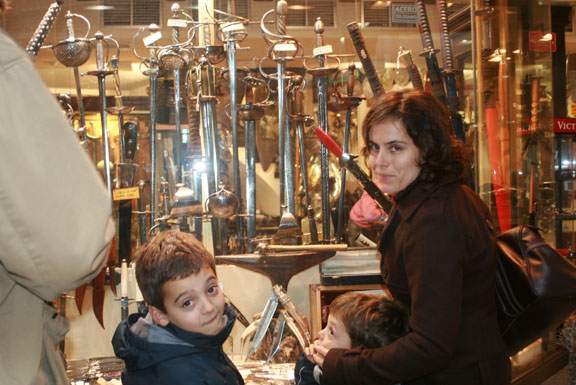
Amaia with her two boys. Some of the swords in the display are originals from the 16th and 17th centuries.
It was a cloudy day with a light drizzle at times, but there were lots of people walking the streets of the old quarter. Toledo’s streets wander up and down with lots of narrow paths between buildings.
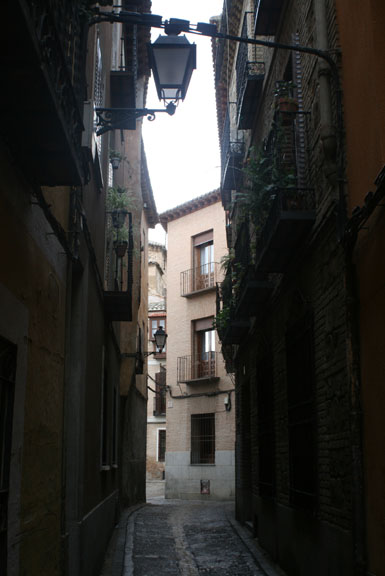
One of the narrow streets with balconies.
There are often street performers in the large cities of Spain and in the metros. In Toledo, one of the performers–Ana Alcaide–played an instrument that from a distance sounded a like a cross between a harp and a violin (to my rather musically-challenged ear). It was a charming sound. She gave me a postcard with the URL of her website: http://www.anaalcaide.com/, and you can hear her here on YouTube.
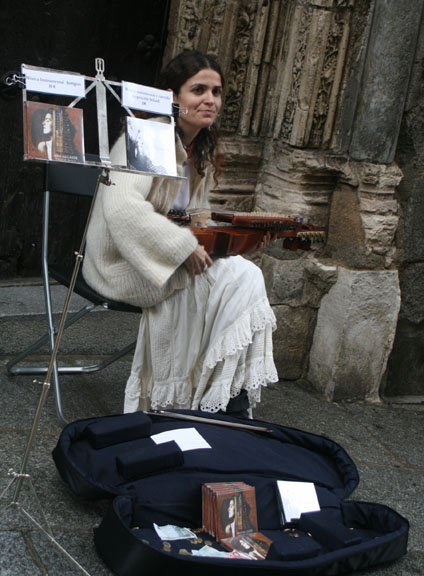
Ana Alcaide performing on the streets of Toledo.
For those interested in musical instruments, I took a photo of it:
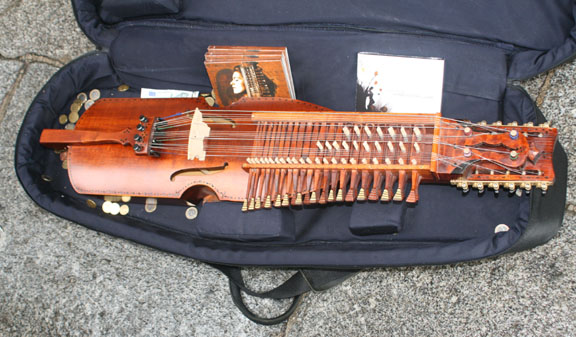
The instrument was called a keyed fiddle (viola de teclas in Spanish and nyckelharpa in Swedish).
Toledo was once famed for its swords. Today, tourists often buy the (relatively) cheap swords that have been made to be hung on walls, but in some of the stores you can find swords made to be used by historical fencers and sometimes originals from 400 years ago that are on sale for a good chunk of change.
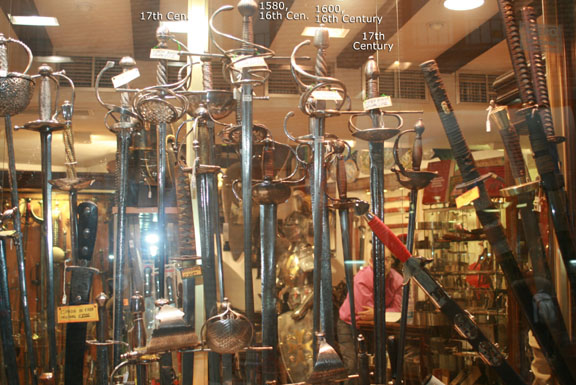
Here is the sword display in the front window of the store Moreno Fernandez.
We also went into the Church of Saint Thomas (Iglesia de Santo Tomé), and I got to see El Greco’s (The Greek’s) famous painting "The Burial of the Count of Orgaz" and listen to a taped description about it.
It was one of those magical moments when you realize that the painting you have seen in books and on the web is right there before you–where it has been for hundreds of years, where a steady hand painstakingly painted it. It also represents the strange mixture of past and present which is all around. The Count of Orgaz was buried in the 14th century; El Greco’s representation of it is from 16th century; and here I am listening to a recording about it, reading about it and looking at it in 2008 (the multimedia experience). Here is a link to the Wikipedia site about the painting, and the Church also has a website: http://www.santotome.org/ (You’ll need Flash for it to work, and the English link wasn’t working for me.).
In spite of the overcast skies, it was a lovely day filled with good company.
(Due to heavy spam on this post, comments are currently blocked on it.)
143 Responses to “Toledo on a Cloudy Day”
Trackbacks/Pingbacks