Filed as General with no replies
Take a moment to realize that when you were a child your parents regularly carried you in their arms. It was a part of your life so common as to be unnoticed.
They picked you up and carried you into the house, they held you while you slept, and they laid you down in your bed.
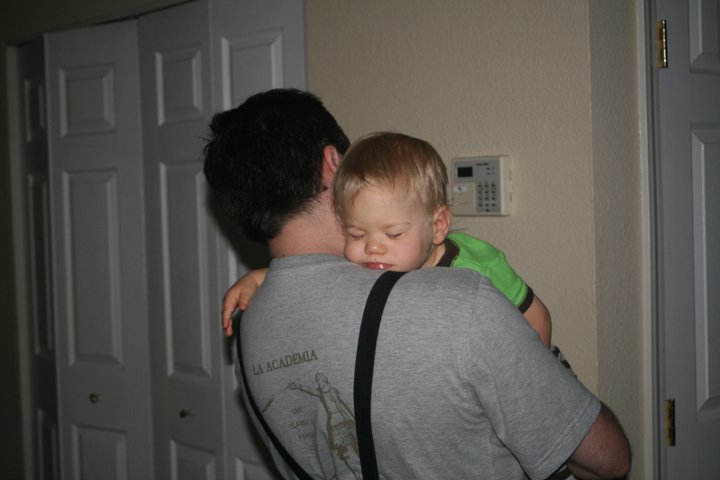
Now realize that on one particular day, that neither you nor your parent recognized, your parent picked you up and carried you for the very last time. You probably do not remember the day when you last leaned your head into your parent’s shoulder as they held you but thinking on it today, you might wish that you did.
If you have a child of your own remember that your last time to carry them is coming and appreciate holding your child today.
There is a last time for everything so use what little time you have.
Filed as Destreza (Spanish swordplay), Fencing, General, Historical Fencing with no replies
What is an Atajo? To understand the Atajo it is useful to understand the primary causes that make it work.
I’m intentionally going to present this from the perspective of a Pachequista (a follower of don Luis Pacheco). Pacheco literally defined the fencing master’s examination in Spain so in this regard his work is “canonical”.
The Advantage of Downward Pressure
If I extend my arm out toward you with the palm up and you press down while I resist you will probably be able to lower my arm. The Spanish call this the superior nature of the natural movement (descending) versus the violent movement (rising). Your own body also provides an advantage when you use your shoulder and body to assist in the motion to increase the downward force.
Principle: If all other factors are equal a downward force will defeat an upwards resistance.
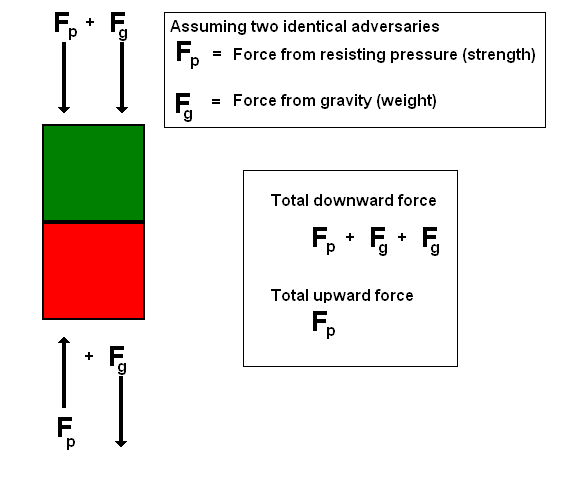
When two equal adversaries resist each other, gravity lends a hand.
The Advantage of Degrees of Strength
I have already written an article about blade mechanics, but every swordsman worth his or her salt should already know that in contact between two weapons, the swordsman with superior degrees of strength in the engagement has an advantage of power both offensively and defensively.
Principle: When two swords oppose each other in an engagement, the weapon with greater degrees of strength is stronger and has an advantage.
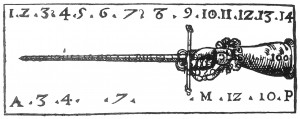
Carranza's degrees of strength showing higher values as stronger.
For more on strength in engagements consider this article:
Spanish Fencing Notation 5 – Strength of the Weapon
The Advantage of Time
When two adversaries act against each other the swordsman who can finish execution sooner has an advantage in time. The Spanish use Movements as a tool for understanding time. When the adversary’s attack requires three movements, he can be defeated by a defense or counteroffense which uses a single movement. In addition an engagement that completely closes a line can limit the adversary’s offensive options to ensure that the time advantage is maintained.
Principle: A defensive action that requires a single movement can defeat an offensive action with more movements.
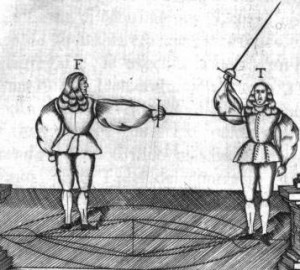
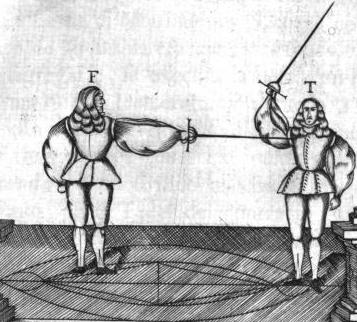
When the adversary attempts to strike with a circular reverse (3 movements) the defender answers with a thrust (1 movement). (Ettenhard Plate 11)
Principle: An engagement which prevents the adversary from attacking in a single motion provides a defensive advantage.
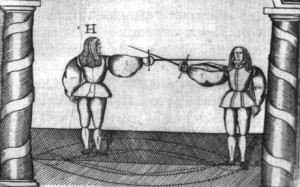
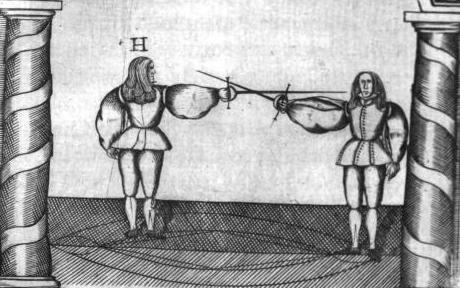
By closing the line, he forces the adversary into a time disadvantage. (Ettenhard Plate 15)
For more on Spanish Movements consider this article:
Spanish Fencing Notation 1 – Vector Notation
Advantage by Domination of the Shortest Path
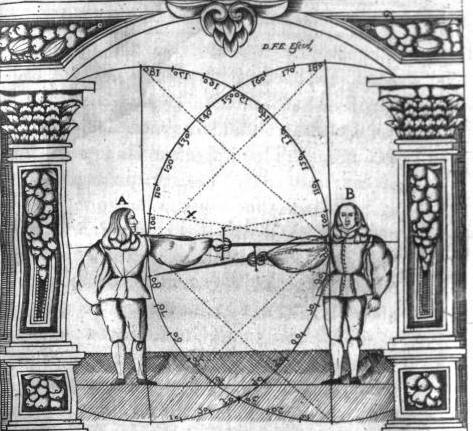
The Spanish fencer starts with the arm extended and the weapon pointed at the adversary along the most direct path to the target. Knowing that it is easier to push downward then to resist upward, I can use this principle to deny my adversary the shortest path to my body by pushing his blade down. Not only do I increase the distance he must travel to strike my body, I also ensure that my offensive path is shorter and closer to the target.
Principle: By starting with the arm extended along the shortest path to the adversary and then deviating the adversary’s weapon downward you ensure your own path to the target is shorter.
Note: Deviating the opposing steel laterally would be called a desvio or a deflection.
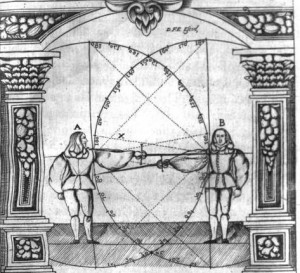
The advantage of the shorter path (Ettenhard Plate 9)
Atajo Defined
The Spanish Atajo unites all of these ideas into a single defensive action which can protect the swordsman while simultaneously providing opportunities and the place from which to strike with safety. Offensively, the atajo can be used to prepare a safe attack that controls the adversary’s weapon. (We would call this preparatory action “dispositive” and the attack “executive“.)
Pacheco in New Science p.365 (1632)
| “Atajo, according to our definition, is when one of the weapons is placed over the other (not in any of its extremes nor with any of its extremes) and with equal or some degree more of strength subjects it and makes it so that the technique that can be formed must be done with more movements and the participation of more angles than those that its simple nature requires.” |
~Translated by Mary Curtis
Pacheco in New Science p.368 (1632)
| “Arriving, then, to the perfect formation of the atajo, it should necessarily consist of three movements: violent, offline lateral and natural. With the first the sword that should subject is placed on a superior plane to the other, with the second it is placed transversal over it, and with the last it subjects it:” |
~Translated by Mary Curtis
Ettenhard in his Compendium and Foundations… p.154-155 (1675)
| “I am very safely confident that one will have recognized with enough satisfaction that the Atajo causes its effects by means of a superior graduation and of the superior power of the Natural Movement and also that one will concede to me that if it were possible to beat and destroy these two causes, we would see dispelled the end of such superior effects…” |
~Translated by Mary Curtis
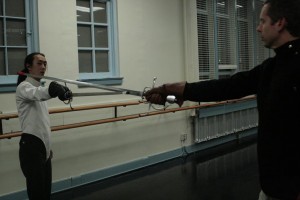
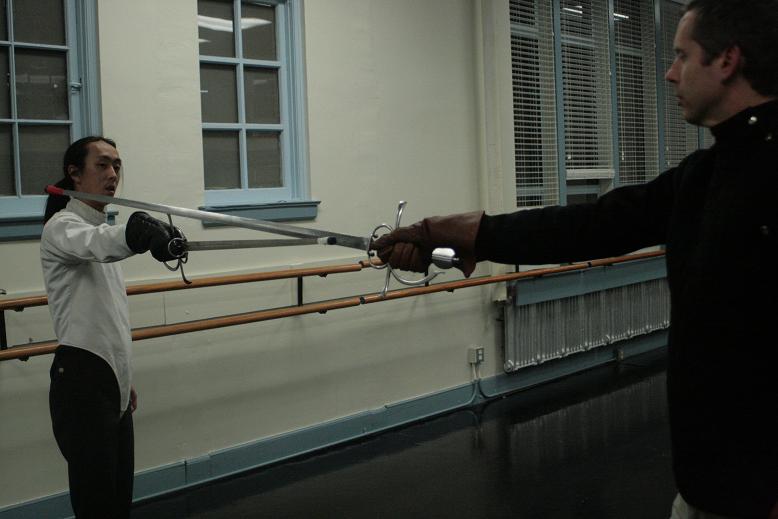
Eric places an Atajo over Kevin's sword. (Click for larger image)
The Defining Elements of Atajo
Between Pacheco and Ettenhard we find these three items essential in placing Atajo:
- Subjection with equal or greater degrees of strength.
- The subjection is placed from above.
- The subjected line is closed so that an adversary cannot strike with a single movement.
When Lorenz de Rada writes later, he adapts the atajo so that you initially seek the subjection from above and if you don’t find it or feel that the adversary is weak in the engagement you immediately spiral towards the opposing steel and closing the opposite line from below. Compare this to the classical transports of 3rd and 4th from high to low or the corresponding half-circular parries from high to low.
Conclusion
This information tells us that Pacheco’s Atajo should start by seeking the superior line with greater degrees of strength in the weapon. The defensive action subjects downward to lengthen the adversary’s path to the target while ensuring your own path is shorter. It might be tempting to equate Atajo with classical engagements but this violates the primary causes of Atajo. Likewise, by definition two swordsmen cannot both have an Atajo simultaneously.
Filed as Classical Fencing, Destreza (Spanish swordplay), Fencing, General, Historical Fencing with no replies
 When a classical instructor from my tradition introduces new techniques each fencing action is taught individually with a focus on form, distance, and timing. Too much emphasis on individual actions can create fencers without depth or the ability to react tactically within the moment.
One of the teaching methods used later in the process is the building of extended phrases of actions to challenge the student. The instructor continually pushes the student with progressively more difficult actions executed in situations more like actual fencing.
By creating an extended sequence, the student is asked to perform at a higher level. Form, Distance, and Timing are still critical and actions executed in extended phrases help to prepare the student for the rigors of the bout.
The 5 Spanish Attacks
- Thrust
- Half Cut
- Half Reverse
- Circular Cut
- Circular Reverse
(For more on the Spanish Attacks read Mary’s Ettenhard Translation )
Our students have been working on these attacks in different situations for the past 9 weeks. At times a focus on technique can feel scripted. While important, technique building work (like repeated lunges in the Italian tradition) may not reflect the action-reaction dynamic that occurs in actual fencing.
By developing a sequence of actions, we provided the students with a glimpse of how a fight could progress and gave some sword-in-hand insight into different choices that could be made in the phrase based on the adversary’s action.
“If he does this, you can respond with this.”
“If he does this instead, consider this response.“
Asking your fencers to consider different tactical options and to think critically about fencing theory in actual practice will create better fencers. Learning to read and adapt to your adversary is one skill that requires attention and practice. There is no substitute in a sword fight for good problem solving skills!
Creating an Extended Phrase
My goal was to include each Spanish attack once during the different mutations of the phrase.
A Guide to My Fencing Notation
Each action is notated once in sentence form as I would call it in a lesson. Then I briefly notate the action again by Movements which is a more Spanish approach. The Spanish notation provides us information about time as well.
Example:
“X. Sentence describing some fencing action…”
- Movement 1 – do this
- Movement 2 – do that
HINT: Count the Movements and you are also counting the tempo. Spanish notation is fairly sophisticated in its ability to simultaneously describe an action and the timing. In Pacheco’s work he often notates an Italian action and then breaks down his tactical responses movement-by-movement. Compare this method to the Bolognese example of notating from starting guard through motion to final guard and you will see a similar idea.
If the notation or jargon looks intimidating, consider peeking at my previous articles to help decode the action.
If there is some interest in this particular phrase, I will do what I can to post a series of videos showing how they can be executed.
The Lesson
Note: All lessons begin and end with a formal salute.
This lesson was performed by pairs of students alternating roles. As the sequence progresses the instructor (the fencer receiving the touch) either invites to initiate the action or responds to the student’s invitation.
Understand the difference between skill-building and fencing
This lesson includes some unrealistic actions. The most heinous example is the initial invitation that removes the point from the line of the diameter. This would be expressly condemned in the Spanish texts because the movement serves no purpose but to create an avenue for the adversary’s attack.
As an instructor, I might use this offline motion as an in-time cue (a motion cue) intended to immediately provoke the student’s attack.
Example: Thrust executed in time
In time as the instructor invites on the outside line, thrust to the chest with a transverse step to the left.
- Movement 1 – Instructor invites with an offline movement left (fingernails up). Student thrusts with a transverse step left.
As the instructor, I certainly want my student to capitalize on a movement of this kind. In this case, we are using the 1-movement thrust. In the lesson below, I use the 2-movement half reverse instead.
On the student’s side it is perfectly reasonable to assume that at some point during a bout, the adversary might deviate your weapon from the line of the diameter (perhaps with a beat). Knowing how to respond when your point has been deviated from the line is valid training and creating this initial disadvantage provides us with a key training opportunity for placing an atajo over the incoming attack.
I should also point out that the thrust has fewer movements (1) than the other attacks (2-3). In the sequence below, there are numerous instances when a thrust would be a faster response than the various cuts. Again, the intention is to force the student to execute certain technical actions like the cutting attacks and placing an atajo under stress.
Thrust (Line in Cross)
1. From the student’s atajo on the outside line, thrust along the diametric to the chest with a curved step right.
- Movement 1 – Student executes a thrust with a forward movement and a curved step right.
Half Reverse
2. From the instructor’s invitation on the outside line, half reverse to the outside cheek with a curved step to the right.
- Movement 1 – Instructor invites with an offline movement left (fingernails up). Student chambers the half reverse with an offline movement left.
- Movement 2 – Student delivers the half reverse with an aligning movement and a curved step right.
Half Reverse & Thrust (Line in Cross)
3. From the student’s invitation on the outside line, the instructor executes a half reverse to the outside cheek with a curved step to the right which the student intercepts with an atajo on the outside line followed by a thrust along the diametric to the chest with a curved step right.
- Movement 1 – Student invites with an offline movement left (fingernails up). Instructor chambers the half reverse with an offline movement left.
- Movement 2 – Instructor delivers the half reverse with an aligning movement and a curved step right which the student intercepts with an atajo on the outside line.
- Movement 3 – Student executes a thrust with a forward movement and a curved step right.
Half Reverse & Half Cut
4. From the student’s invitation on the outside line, the instructor executes a half reverse to the outside cheek with a curved step to the right which the student intercepts with an atajo on the outside line followed with a half cut to the inside cheek and a transverse step left.
- Movement 1 – Student invites with an offline movement left (fingernails up). Instructor chambers the half reverse with an offline movement left.
- Movement 2 – Instructor delivers the half reverse with an aligning movement and a curved step right which the student intercepts with an atajo on the outside line.
- Movement 3 – Student executes a half cut with an aligning movement and a transverse step left.
Half Reverse & Circular Cut
5. From the student’s invitation on the outside line, the instructor executes a half reverse to the outside cheek with a curved step to the right which the student intercepts with an atajo on the outside line. In response the instructor seeks to increase degrees of strength in the engagement with a movement of increase and attempts to gain an atajo on their own outside line. The student eludes the movement of increase with a circular cut to the inside cheek with a curved step to the right.
- Movement 1 – Student invites with an offline movement left (fingernails up). Instructor chambers the half reverse with an offline movement left.
- Movement 2 – Instructor delivers the half reverse with an aligning movement and a curved step right which the student intercepts with an atajo on the outside line.
- Movement 3 – Instructor uses a mixed violent and aligning lateral movement in an attempt to execute a movement of increase and place an atajo on his own outside line. In response the student executes an offline movement left to escape the engagement.
- Movement 4 – Student chambers the circular cut with a violent movement.
- Movement 5 – Student delivers the circular cut with a natural movement with a curved step right.
(Movements 3 & 4 may be combined into a mixed movement offline and violent to elude the engagement and chamber the circular cut simultaneously.)
Half Reverse, Circular Cut, & Half Reverse
6. From the instructor’s invitation on the outside line, the student executes a half reverse to the outside cheek with a curved step to the right which the instructor intercepts with an atajo on the outside line. In response the student seeks to increase degrees of strength in the engagement with a movement of increase and attempts to gain an atajo on their own outside line. The instructor eludes the movement of increase with a circular cut to the inside cheek and curved step to the right. The student intercepts the circular cut with an atajo on the inside line and executes a half reverse to the outside cheek with a curved step to the right.
- Movement 1 – Instructor invites with an offline movement left (fingernails up). Student chambers the half reverse with an offline movement left.
- Movement 2 – Student delivers the half reverse with an aligning movement and a curved step right which the instructor intercepts with an atajo on the outside line.
- Movement 3 – Student uses a mixed violent and aligning lateral movement in an attempt to execute a movement of increase and place an atajo on his own outside line. In response the instructor executes an offline movement left to escape the engagement.
- Movement 4 – Instructor chambers the circular cut with a violent movement.
- Movement 5 – Instructor delivers the circular cut with a natural movement and a curved step right which the student intercepts with an atajo on the inside line.
- Movement 6 – Student uses an aligning lateral to deliver a half reverse with a curved step right.
(Movements 3 & 4 may be combined into a mixed movement offline and violent to elude the engagement and chamber the circular cut simultaneously.)
Half Reverse, Circular Cut, & Circular Reverse
7. From the instructor’s invitation on the outside line, the student executes a half reverse to the outside cheek with a curved step to the right which the instructor intercepts with an atajo on the outside line. In response the student seeks to increase degrees of strength in the engagement with a movement of increase and attempts to gain an atajo on their own outside line. The instructor eludes the movement of increase with a circular cut to the inside cheek with a curved step to the right. The student intercepts the circular cut with an atajo on the inside line. The instructor responds with a movement of increase attempting to place an atajo on their own inside line and the student responds with a circular reverse to the outside cheek with a transverse left or a circular step left depending on the distance.
- Movement 1 – Instructor invites with an offline movement left (fingernails up). Student chambers the half reverse with an offline movement left.
- Movement 2 – Student delivers the half reverse with an aligning movement and a curved step right which the instructor intercepts with an atajo on the outside line.
- Movement 3 – Student uses a mixed violent and aligning lateral movement in an attempt to execute a movement of increase and place an atajo on his own outside line. In response the instructor executes an offline movement left to escape the engagement.
- Movement 4 – Instructor chambers the circular cut with a violent movement.
- Movement 5 – Instructor delivers the circular cut with a natural movement and a curved step right which the student intercepts with an atajo on the inside line.
- Movement 6 – Instructor uses a violent and aligning lateral movement in an attempt to execute a movement of increase and place an atajo on his own inside line. In response the student executes an offline movement right to escape the engagement.
- Movement 7 – Student chambers the circular reverse with a violent movement.
- Movement 8 – Student delivers the circular reverse with a natural movement while stepping transverse left or curved left depending on the distance.
(Movements 3 & 4 may be combined into a mixed movement offline and violent to elude the engagement and chamber the circular cut simultaneously.)
(Movements 6 & 7 may be combined into a mixed movement offline and violent to elude the engagement and chamber the circular reverse simultaneously.)