

On Orthodoxy in Destreza
Let’s talk about the atajo for a moment and compare Pacheco’s Atajo with Carranza’s.
Pacheco tells us that there are 3 movements:
• Rising (violent) to lift the blade
• Offline (remiss) to cover the opposing blade
• Descending (Natural) to subject it
Pacheco also has rules about the atajo:
• It must be placed from above
• It must subject with equal or greater degrees of strength
• It must not participate in extremes
• It must close the line such that the adversary cannot strike you with a single movement
Within that space, Pacheco has a lot of freedom.
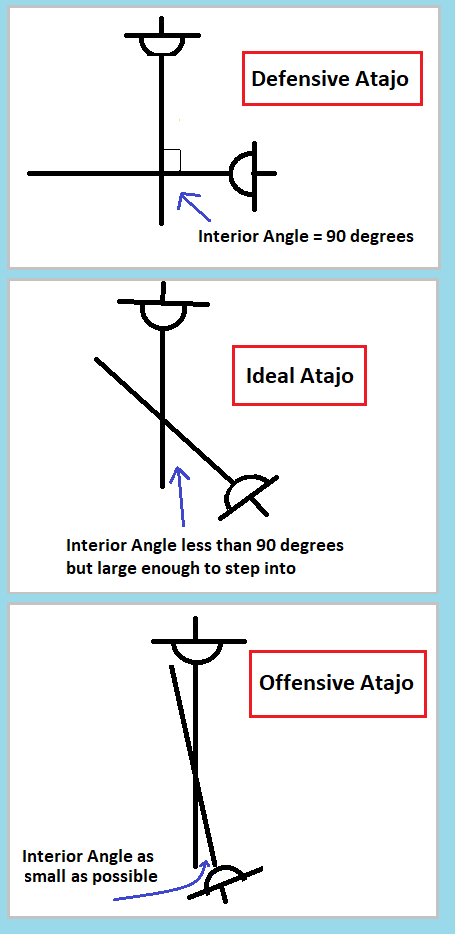
Your most defensive atajo creates a true cross (90-degrees) across the other sword. The smaller the interior angle gets between the swords, the less defensive power you have but your offensive potential increases. You still can’t let go of all that crossing power because you need to close the line. For the moment, let’s ignore anything less than 20 degrees in the cross. Let’s also leave out anything that isn’t in 10 degree increments even though we know 37 degrees in the cross exists and we can do it. That gives us 30, 40, 50, 60, 70, 80, and 90 degrees in the crossing of blades to make atajo for 7 valid options.
Interior Angle = 7 choices
We’re going to work in the middle of the adversary’s blade and that blade has 10 degrees of strength. To avoid extremes, we’ll only take the middle ones of 4,5,6, and 7. That’s 4 options. (Let’s also ignore that we can choose which part of our blade we use and just assume we’re always equal.)
Interior Angle and Degrees of Strength = 7 x 4 = 28 possible choices
Now we’re going to vary the height of the hilt by dropping our hand while lifting the tip to create that characteristic plow shape for the atajo’s engagement. Lower hilt means we increase the size of the opponent’s circular actions. Let’s call that 0-4 in which 4 is as low as our waist and 0 is parallel to the floor with the arm extended for 5 options.
7 x 4 x 5 = 140 choices
What about the pressure in the blade? Are we soft or hard? What about the step we take with the atajo? Or no step at all. Every one of these makes our number of choices explode exponentially and all of them are valid choices inside Pacheco’s framework for atajo.
Even our most orthodox master is really providing the fencer with this overwhelming ocean of possible atajos and it’s on us to choose correctly. Even Pacheco wouldn’t be comfortable with us keeping our hands in very fixed places because that would be the absolution of our responsibility to choose the ideal Medio.
But, what about Carranza? Carranza is principle-based and he is also a choose the beautiful Medio guy. He’s always critically examining swordplay to look for the truth, and he seeks demonstrations and tests to verify that his ideas work. Natural power defeats violent. Smaller movements beat larger movements. We know that he’s using a cause-based reasoning system to interrogate swordplay and that he intentionally tailors the training to the student’s body and spirit.
His definition is: “Atajo in the destreza, is when one of the weapons is placed over the other, so that the one that is apt to move away has fewer places by which to escape.”
Carranza is always there in the background with matches and a smile waiting to burn down our cathedrals if they become a home to falsehoods.
If Carranza found that a student couldn’t form atajos because they were too short to place them on a much taller adversary’s weapon you have to believe that his answer would be, “Fuck the atajo. If it doesn’t work for you, we’re doing something else.”
This isn’t a permission slip to go crazy with nonsense technique. He and Pacheco are closer allies than you would think. Pacheco gives you all these rules and expects you to take responsibility within his orthodoxy to choose the right answer. Carranza gives you the entire universe and expects you to find the right answer. Pacheco has captured the culture and tradition of Destreza in his writing. He has made the problem easier to solve by giving you system and structure.
Carranza has given you a discovery process and it’s the first guiding principle of Destreza, always seek the truth. Identify the fundamental causes of the challenge and use that to get to the truth. Once you understand, test your answers over and over again. Doing that gives you knowledge and practice will give you art.
It could be that your causes are to recreate a historical duel, or to rediscover the system practiced by a specific author, or to fence for sport, or create a hybrid Italian-Spanish system, or to experience a little joy with your friends. All of these are totally valid causes from which a Destreza can be derived. Your own body, weapons, and opponents will make your Destreza live in your unique body. The diverse causes result in different unique expressions of Destreza and they’re all valid and you’re striving to do this thing with good character.
I certainly have my opinions about what is good Destreza and I know (more or less) what my causes are on any given day.
All this to say, Destreza is for everyone because truth is for everyone. Destreza plainly tells us that if someone has something different about their body, it is our responsibility to seek the truth, to test our theories, and to train towards art in way that serves that person. Ideally, we preserve the tradition so that it’s recognizably still part of our family but always truth is the beginning, practice is the journey, and art is the destination.